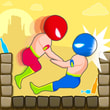
🍩🏀 A hoop in the sky, a ball on a string, and your patience evaporating
Slam Dunk Forever starts with the kind of setup that looks like a joke until it isn’t: a basketball hanging from a rope, a hoop sitting there like it’s judging you, and a simple promise that feels almost insulting—just cut the rope and dunk it. Easy, right? Then you do it once, watch the ball swing like it has its own opinions, bounce off something you didn’t respect, and miss by a hair. Suddenly it’s not “easy.” It’s personal. This is a physics puzzle basketball game on Kiz10 where your weapon is timing, your enemy is impatience, and the court is basically gravity with a sense of humor.
The best part is how quickly the game pulls you into that “one more try” mindset. Because the levels are short, the feedback is instant, and every miss feels fixable. You don’t lose and think “random.” You lose and think “I cut too early,” or “I didn’t account for the swing,” or “why did I trust that bounce.” The game is constantly nudging you to learn the arc, learn the rebound, learn how the ball behaves after you cut, because the cut is not the end—it’s the beginning of the chaos.
🧵✂️ The cut is your move… the swing is the consequence
Slam Dunk Forever isn’t a tap-to-score arcade shooter where you flick and pray. It’s a rope-cut logic game wearing a basketball jersey. When you cut, you’re not just releasing the ball. You’re releasing momentum. You’re deciding where the ball will travel next, how it will fall, what it will hit, and whether it will arrive at the hoop like a clean swish… or like an embarrassing clunk that makes you stare at the screen in quiet disbelief.
A lot of the challenge is reading the rope like it’s a clock hand. The ball swings, the angle changes, and you learn that the “perfect moment” isn’t always when the ball lines up with the hoop. Sometimes you need to cut a fraction earlier so the arc carries it forward. Sometimes you wait longer so the swing slows down and becomes controllable. And sometimes you think you’ve found the perfect timing and the ball bounces off the rim like it’s offended you tried. That’s the vibe. It’s playful, but it’s strict.
🧲🟠 Physics feels friendly until you start caring about being perfect
At first, you’ll probably brute force a few levels. Cut, watch, adjust, repeat. But the moment you start chasing clean dunks, the game shifts. You begin noticing tiny details: the speed of the swing, how the ball rebounds off surfaces, how a small nudge changes the whole outcome. Your brain starts doing those quiet calculations without asking permission. If I cut here, it drops into the hoop. If I cut there, it hits the side. If I wait one beat, it lands cleaner. You’re basically doing mini-physics homework, except the homework is fun because it ends with a dunk.
The funniest part is that the game doesn’t need a timer to make you feel pressure. Your own desire to “get it right” becomes the timer. You’ll hesitate, then panic-cut, then instantly regret it. Or you’ll overthink a simple level, cut late, and watch the ball gently miss like it had all the time in the world to disappoint you. 😅
⚡🎯 Bonus points turn calm puzzle-solving into spicy decision-making
Slam Dunk Forever isn’t satisfied with “just score.” It teases you with bonus points and extra rewards that push you toward riskier choices. You’ll see a bonus target sitting in a place that clearly isn’t safe, and your brain will do the classic gamer thing: “I can get that and still dunk.” Sometimes you can. Sometimes you get the bonus and sacrifice the dunk, which is the kind of trade that feels awful for half a second and then funny because you did it to yourself.
Those bonus mechanics are what keep levels from feeling too straightforward. They add a layer of planning. Not huge planning, but enough to make you pause and ask: do I want the safe dunk, or do I want the stylish dunk with extra points? That question becomes the heart of the game, because it turns a simple rope cut into a choice with consequences.
🏗️🧩 Levels that feel like tiny trick-shot stages
As you progress, the setups get more clever. The hoop placement changes, the obstacles become more annoying, and your easy instincts start betraying you. A cut that worked in one level fails in the next because the arc is different. A bounce you relied on suddenly becomes unreliable because the surfaces are angled differently. The game quietly teaches you not to rely on one solution style. You can’t just cut instantly every time. You have to read the room.
And when you finally solve a tricky level, it feels like you pulled off a trick shot in front of an invisible crowd. The satisfaction isn’t just “I passed.” It’s “I understood the level.” That’s what makes Slam Dunk Forever feel satisfying on Kiz10: it’s skill-based, but in a thoughtful way. You’re improving your timing and your ability to predict motion, not grinding random luck.
😈🏀 The rim is innocent. The rim is also your villain.
There’s a special kind of pain in physics basketball games: the rim. It looks harmless. It’s just a hoop. But the rim has a personality in your head after a few misses. It becomes the thing you blame when you know the real culprit is your timing. You’ll hit the rim and bounce out, and you’ll swear it was unfair. Then you’ll replay, cut slightly differently, and swish it cleanly, and suddenly the rim is your best friend again. This emotional whiplash is part of the charm.
Slam Dunk Forever is not trying to be realistic basketball. It’s trying to capture the emotional rhythm of basketball: attempt, bounce, heartbreak, redemption. But it does it through ropes and gravity instead of dribbling and shooting. And somehow it still feels like basketball in the most important way: you want the clean dunk. You want that satisfying drop through the net. You want the moment where it looks effortless, even though you know you just spent eight attempts getting there.
🧠✨ How to play smarter without turning it into a science lecture
If you want better results, the best habit is waiting one extra beat before you cut. Not always, but often. That tiny pause gives your brain time to read the swing and gives the ball a more predictable arc. Also, aim for clean lines instead of “close enough.” A ball that barely grazes the rim is a ball that might bounce out. A ball that enters centered is a ball that behaves.
And when you’re tempted to chase bonuses, do it with a plan. If grabbing a bonus forces a wild swing, you’re probably turning a simple dunk into a gambling session. Sometimes that’s fun, and you should do it. But if you’re stuck, go for the clean dunk first, then come back for the bonus run once you’ve learned the level’s physics. That approach saves your sanity.
Slam Dunk Forever on Kiz10 is a clever rope-cut basketball puzzle that turns a simple “slice the rope” idea into a full physics challenge full of rebounds, timing, and tiny moments of victory that feel way bigger than they should. If you like trick-shot logic games, quick levels, and the satisfactions of watching a dunk finally go in after you outsmarted gravity, this one is pure fun. 🏀✂️






 Share
Share
 Embed
Embed