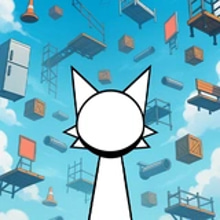
The world tilts its head and everything that should sit quietly on the ground decides to float. A bench drifts past a streetlight. A stair rail hangs in midair like an unfinished thought. Crates, pipes, billboards, traffic cones, and whole rooms have slipped their anchors and stacked themselves into a crooked ladder that points to the sky. Sprunki Only Up hands you a simple rule and a huge playground. Go up. Not sideways for long, not down except to learn, just up, as far as nerve and timing can carry you. You pick a character, take a breath, and let your hands find a rhythm that turns panic into precision.
The first step is always the loudest inside your head. You hop to a floating plank, test the friction, and learn that movement has intention. A small tap nudges you into place. A long press gives a committed leap you have to mean. The second step is a conversation with gravity. You feel how much air you can buy with a clean jump and how a late press robs you of inches that matter. By the third step you are already building a mental map of what happens if you slip. You will fall, yes, but you will also spot a lower route you missed and land on something that invites a smarter climb. That is the secret of this kind of platformer. Failure is not a wall. It is a tour guide with a raised eyebrow.
Double jump changes the language of the climb. The first jump is a promise. The second is a correction or a statement of style depending on how honest the first one was. Early on you will spend the second jump saving clumsy angles and catching edges with your toes. A little later you will start using it to arc over gaps you once avoided and to stitch together routes that only exist if you commit to them in midair. The move does not make you reckless. It makes you brave in a way that feels earned, because you still have to place the second press at the exact moment the world agrees to help.
Sprunki’s vertical sets are stitched from familiar objects that behave in unfamiliar ways. A ladder floats upright but sways in your mind because the next platform sits at a teasing diagonal. A city sign becomes a runway. A bundle of pipes offers three thin lines that reward balance with clean momentum. You learn to read surfaces at a glance. Rough textures forgive late landings. Smooth metal wants centered feet. Narrow rails expect a soft approach and a straight exit. As you move higher, the spaces between safe spots stretch just enough to keep your attention honest. You stop sprinting thoughtlessly. You start placing your character like a climber who respects edges.
The camera earns your trust when you let it. Pan a little before you leap and it will reveal the path the level is hinting at. Tilt too late and you will be guessing at empty sky while your feet argue with a pipe. Good play becomes a rhythm. Glide, look, jump, correct, land, breathe, look again. When the rhythm holds, Sprunki gives you a feeling that is part focus and part daydream, a narrow bubble where the world is only edges and timing and a slow smile when a hard section finally feels soft.
Choosing a character is not just a cosmetic pick. It is a motive. One avatar makes you feel lighter, and you move like a person who trusts long arcs. Another looks grounded, and you find yourself choosing conservative lines that make elegant sense. The levels do not change, but your reading of them does, which is why swapping late in a session can feel like playing a remixed route. There is a pleasure in recognizing that your habits were attached to a silhouette instead of a rule. That recognition is progress, the kind that slides into the next climb without a chart.
Momentum is the quiet currency. If you land facing the next jump, you can chain a double with a tiny hop and barely lose height between beats. If you land sideways, you waste seconds squaring up and invite nerves to talk. You will discover micro habits that add up. Turn in the air so you arrive aimed. Tap forward a hair before landing so your feet kiss the surface and leave again. Nudge the camera while you are airborne so the next platform is inside your eyes when you need it. None of this is flashy. All of it is the difference between scrambling and sailing.
Falling deserves its own paragraph. It happens. It will feel rude. It will also be instructive when you let it. You will drop past sections you solved cleanly and notice lines you did not see from below. You will catch a plank at the last moment and feel a jolt that wakes your hands and clears your head. The game is honest about consequence, but it is also generous about recovery. There is almost always a way to turn a long fall into an educational detour. That is why stubbornness works here if you pair it with attention.
The soundscape supports focus. Jumps click with a tidy confirmation. Landings give a soft thud that tells you how centered your feet were. Wind hums a little higher as the city shrinks and the sky opens. Music stays out of the way until a section wants encouragement, then steps forward with a pulse that matches your cadence. With headphones you will feel your timing sharpen. On speakers you will still hear enough to know when a long gap wants a longer press.
Visual clarity keeps the climb fair. Foreground edges read clean against the sky. Depth is legible without overdone shadows. Important ledges pop with contrast rather than neon. Even at speed, the world is readable, which frees your brain to plan instead of decode. That clarity turns the hardest sections into solvable sequences. You are never fighting the presentation. You are negotiating with your own nerve.
Short sessions matter because each attempt teaches a single new truth. A twenty minute run can carry you past a skyline you thought was a ceiling yesterday. Share a clip and a friend will spot a line you missed. Try it, and your hands will memorize the shape for the next time a similar arrangement appears. That is the quiet loop that keeps players returning. Not loot. Not unlocks. Just skill that you can feel inside your fingers and see in the way your character stops hesitating near edges that used to frighten you.
At some point, clouds slide past and the colors thin into higher air. The objects feel stranger up here. A roof garden hovers above a billboard that once sat on it. A train car balances on two telephone poles that have no business standing this far from the ground. You thread them together anyway, because by now your sense of what is possible is larger than the level designer’s prank. When you finally plant both feet on a platform that has nothing above it but stars, you do not cheer. You breathe, you grin at the view, and you look for one more ledge because you have learned to like the climb as much as the height.
Sprunki Only Up is a clear invitation to practice calm in motion. Move with intention, use the second jump as punctuation rather than panic, aim the camera like a partner, and accept that a fall is not an ending but a reroute. The sky does not stop. You do not have to either. Point your character upward and let the world arrange itself into a ladder you can read. The first dream of space lives here, at the edge of a railing and the start of a clean jump.





 Share
Share
 Embed
Embed


