🧨 Welcome to your own disaster factory
Stick Create a Level does something evil and brilliant at the same time it lets you design the exact kind of rage level you usually complain about, then makes you play it yourself. There is no noble knight, no shiny sports car. Just a stick figure jammed into a metal pot, holding a hammer that doubles as your only way to move. You look at the empty map for a second and think this will be easy. Ten minutes later you are dangling from a single pixel of a platform, wondering who designed this and then remembering oh right, it was you.
From the first launch the game feels like a physics toy box. Everything is simple at a glance two dimensional, colorful, almost friendly. But the moment you start dropping traps, blocks and weird gadgets onto the screen, you can feel the potential for chaos stack up. This is a sandbox game where the enemy is not some AI villain. It is your own creativity spiraling out of control.
🪓 Ragdoll in a pot, zero dignity, maximum comedy
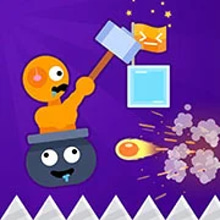
You are not controlling a smooth parkour hero. You are piloting a stick ragdoll crammed into a pot, trying to move using nothing but a hammer that hooks onto things. Every push, swing and awkward shove is powered by physics. When you slam the hammer into the ground and pull, the pot scoots. When you catch the edge of a block, you haul yourself up with a motion that looks like determination and panic at the same time.
Nothing about it is graceful at first. You flail. You spin. You jab the hammer at the exact wrong angle and send yourself sliding down the side of your own level like a sad spoon in a sink. The controls are simple move, swing, anchor the hammer but the way those actions combine feels slippery and alive. Once you start to get a feel for it, though, your brain clicks into a different gear.
You begin to see lines through the level that only exist because of the way your hammer can pivot and latch onto edges. A single well timed swing can fling you past three traps. A delicate tap on the side of a block can correct your fall just enough to land on a safe ledge instead of a bed of spikes. Your stick figure stops feeling like dead weight and starts feeling like an uncooperative but lovable stunt performer who just needs clear instructions.
🧱 Building your dream nightmare
The create part of Stick Create a Level is where the game really opens up. You are given an editor filled with toys blocks, spikes, saw blades, trampolines, springs, cannons, ice platforms, save points and more. You pick a piece, drop it into the world and immediately start imagining the disaster it will cause.
Want a simple training map Place a few blocks, add one or two spikes and a trampoline to bounce over a gap. Want nonsense Design a vertical corridor of spinning saws, place an ice platform where you know you will slide out of control, then put the finish flag tauntingly close at the very top. The only real rule is that your level has to be possible to complete. Beyond that, the editor pretty much says go for it and shrugs.
The best part is testing on the fly. Build a section, then instantly jump in as the stick figure and see if your idea makes any sense. Sometimes you glide through perfectly and feel like a genius. More often you discover you have created something borderline evil. A jump that looked fine on paper is actually impossible without a ridiculous hammer swing and a lucky bounce. An ice platform that felt harmless turns into a frictionless slide straight into a saw. You go back, nudge a block up or down, and try again.
There is a quiet satisfaction in tuning a level until it feels fair but mean. Difficult enough to make you sweat, generous enough that when you finally clear it, you know it was skill and not pure luck.
❄️ Spikes, ice and tiny physics experiments
Every object in Stick Create a Level has its own personality. Spikes are honest they do not move, they just sit there like sharp little bullies waiting for you to slip. Saws are louder and more dramatic, spinning and humming as they chew through any misstep. Trampolines feel playful until they send you bouncing way higher than expected, right into something you definitely did not intend.
Ice tiles are pure comedy. Your ragdoll pot hits the surface, loses grip and suddenly that careful, controlled movement turns into a slide that ignores your plans completely. You jam the hammer into the floor, trying to catch something, anything, while your character skids toward danger with the emotional energy of a banana peel on roller skates.
Cannons and springs let you play with momentum. Launch yourself across huge gaps, chain a cannon shot into a bounce into a swing and suddenly the level feels less like an obstacle course and more like a weird circus act. Save points are your mercy mechanic. Place one in the middle of a brutal stretch and you will be grateful every time you respawn there instead of starting all the way from the beginning.
Testing how these pieces interact becomes its own mini game. You drop a spring on ice just to see how far the ragdoll flies. You line up a cannon so that it shoots you past a row of saws with only a pixel of clearance between survival and disaster. The editor turns you into a low key physicist who measures success in laughs and near misses instead of charts and graphs.
🤯 From harmless doodles to full rage courses
At first your levels look like doodles a few platforms, one or two traps and a finish flag that sits comfortably in reach. It feels cute, almost cozy. Then you clear your own design a few times and your brain gets bored. You start adding more. One more saw. One more spike. Maybe another trampoline above that so you have to bounce and then grab a hook point with the hammer before falling back down.
Slowly, your maps morph from training wheels into challenge runs. You stack hazards in ways that force you to think ahead three moves. You build cramped tunnels that require pixel perfect hammer handling. You create long climbs where a single slip can send you tumbling back through every obstacle you passed a minute ago.
That is when the real stick creator mindset appears. You are no longer just trying to reach the finish. You are trying to do it with style, clean lines, fewer mistakes, maybe a little swagger. You start timing how long it takes you to clear your own level. You curse out loud when you fail just before the end. You tweak details not because the level is impossible but because you want it to feel smoother, more satisfying when everything goes right.
The game never tells you how serious to be. You can spend an hour polishing one evil masterpiece, or you can throw together a goofy mess of cannons and springs and laugh as your ragdoll launches into the sky over and over. Both approaches are valid. Both are fun.
😂 Why failing here feels weirdly good
Usually, games try to hide failure. Stick Create a Level leans into it. Every time your pot slams into a spike or your stick figure gets flung off the edge of the world, the physics spin it into something slightly different. Sometimes you flop in a completely unexpected way and just start laughing, even though you know you have to restart.
Respawns are quick enough that frustration does not have time to harden. You mess up, the game drops you back in and your fingers are already moving before your brain can overthink it. It becomes this loop of try, fail, chuckle, adjust, try again that feels more like practicing a trick than losing.
Because you built the level yourself, there is no blaming some invisible designer in the background. If a jump is too nasty, that is on you. If a stretch feels unfair, you can fix it. That sense of control softens the sting of falling for the tenth time. You know that with one small edit or a slightly sharper swing you can turn a painful section into your favorite moment in the whole course.
🎮 Why it fits so well on Kiz10
Stick Create a Level feels made for quick browser sessions on Kiz10. You can hop in, build a tiny section, test it a few times, then close the tab and come back later without losing the vibe. Or you can sit down for a longer session and completely disappear into level design mode, tuning every trap until the run feels just right.
Controls stay straightforward whether you are on keyboard, mouse or touch. Swinging the hammer becomes second nature. Placing objects in the editor turns into a relaxed drag and drop routine once you understand what each piece does. Underneath the simple interface, though, there is a ton of room for experimentation and skill.
If you enjoy physics sandbox games, ragdoll chaos, stickman challenges or that very specific feeling of yelling at a level while secretly loving it, this game slides right into your Kiz10 favorites. It gives you the tools to build exactly the type of challenge you crave, then dares you to beat it with nothing but a hammer, a pot and a stubborn little stick figure that refuses to stay down.



 3.5 (156 votes)
 Share
Share
 Embed
Embed