🏙️🧩 Welcome to a city that refuses to stay still
Twisted City looks friendly for about two seconds. You see neat little buildings, clean blocks, cute roads… and then you realize the streets are broken into puzzle pieces like the city got dropped on the floor and nobody bothered to put it back together. So yeah, that’s your job now. On Kiz10, this is one of those “simple idea, sneaky brain workout” puzzle games where the entire challenge is rotation, alignment, and that tiny inner voice that goes, “Wait… if I turn this corner, does it help or ruin everything?” 😅
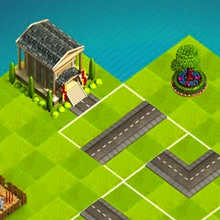
The goal isn’t to race. It isn’t to fight. It’s to create order. You rotate road tiles until the paths connect correctly, linking buildings so cars can reach their destinations. That sounds peaceful, almost relaxing… and it can be. But once the puzzles get denser, Twisted City turns into a sweet kind of tension: the kind where you’re one rotation away from a perfect solution, and also one rotation away from making the whole layout worse.
🚗🛣️ The rules are clean, but the puzzle is not
Twisted City works because it doesn’t dump a rulebook on you. You look at the map, you look at the disconnected street pieces, and you instantly understand what you’re supposed to do. Rotate roads. Connect routes. Make the city functional again. It’s intuitive, which is dangerous, because intuitive games trick you into thinking you’ll solve everything quickly. Then the game starts layering complexity in the quietest way. One extra intersection. One more destination. A tile that can connect in several tempting directions. Suddenly you’re not just rotating, you’re planning.
And planning in this game feels personal. You’re not placing random pieces and hoping. You’re reading the board like it’s a little traffic story. If I connect this road here, that building gets access… but then I block the path to the other side. If I rotate this T-junction, I can serve two routes at once… but only if the next corner lines up. The city becomes a logic maze disguised as cute streets.
🧠🔄 Rotation is easy… choosing what to rotate first is the real fight
Here’s the funny part. The mechanic is literally “turn the tile.” But the skill is deciding which tile deserves your attention first. When you’re new, you rotate whatever is closest to your eyes. You spin pieces until something looks right. Sometimes it works. Sometimes you accidentally create a path that looks correct but leads nowhere useful, like building a beautiful bridge to an empty field 😭.
Then you start playing smarter. You pick anchors. You find key buildings that clearly must connect. You trace the shortest path and build outward. You look for dead ends and fix them early. You treat intersections like power pieces because they can either save a puzzle or destroy it. That shift is the moment Twisted City becomes addictive. Because now you’re not guessing. You’re solving.
🏗️🗺️ The city is a map, but it behaves like a puzzle box
A good road-connection puzzle doesn’t just ask you to connect point A to point B. It asks you to connect multiple points without breaking anything, and Twisted City leans into that. The board becomes a puzzle box where every correct connection has consequences. Fix one route and another might become impossible. Or you might realize you’ve been building a nice highway that doesn’t actually touch the building you needed. That moment stings, but in a good way, because it’s a clean lesson: in this city, “almost connected” is the same as “not connected.”
And because the tiles rotate, you can always change your mind. That freedom is why it stays fun. You can experiment. You can try a weird configuration just to see if it opens the board. You can backtrack without punishment. The game encourages curiosity, and curiosity is basically the best fuel for puzzle games.
😅🧩 The “I swear this should work” moment happens a lot
Twisted City has a special talent for making you confident right before it humbles you. You’ll look at a section and think, this is obvious. Rotate this corner, connect this straight piece, done. Then you realize the road connects perfectly… to the wrong side. Or you made a loop that looks gorgeous but doesn’t actually route traffic to the destination. Or there’s one tile that can rotate two ways and both ways look correct until you trace the full line. Your brain will do that thing where it pretends it didn’t just waste time. It’ll go, “No, no, I was testing.” Sure. Of course you were. 😭
But that’s the charm. The puzzles aren’t just about seeing the next move. They’re about seeing the whole chain. The game quietly teaches you to zoom out and trace routes like a little city planner. Which sounds boring until you realize it feels amazing when you finally create a clean, working network.
🚦🧠 Strategy that actually helps without turning the game into homework
If you want to feel instantly better at Twisted City, there’s a simple mindset shift: stop rotating randomly, start tracing routes. Pick a destination building and follow the road pieces out from it. Ask what kind of connection that tile needs. Straight? Corner? T-junction? Cross? Then rotate with purpose. Another good trick is to treat the edges of the board as constraints. Edge tiles usually have fewer valid orientations, so they can become starting points. Once the edges make sense, the center often becomes easier, because the puzzle has fewer degrees of freedom.
Also, don’t fall in love with the first layout that looks good. Puzzle games love “pretty traps.” A road can look beautifully connected while still failing the actual objective. Trace it. Confirm it. Then celebrate.
✨🏙️ Why it’s so satisfying when it clicks
Twisted City creates a very specific kind of satisfaction: the “snap into place” feeling. You rotate one tile and suddenly three routes become possible. You rotate another and a dead zone becomes a clean highway. You watch the city go from fractured to functional, and it feels like you repaired something real, even though it’s just tiles on a screen. That sense of repair is powerful. It’s calming, but also engaging. You’re not just passing time. You’re shaping the board.
And because it’s a Kiz10 puzzle game, it fits perfectly for short sessions. You can solve a couple of levels, feel smart, then leave. Or you can chase that deeper flow state where you stop thinking in words and start thinking in connections, rotations, and paths.
🏁🚗 Final vibe: small puzzles, big “one more level” energy
Twisted City is the kind of game you start because it looks simple, then you keep playing because you want to solve the next board cleaner. You’ll replay a level not because you must, but because you know you can do it faster, with fewer rotations, with less hesitation. It’s a road-connection puzzle that respects your brain without pretending to be complicated. Rotate, connect, trace, solve. Build a city that finally makes senses… and try not to get emotionally attached to a road layout that’s secretly wrong. 😅🏙️🧩





 4.2 (31 votes)
 Share
Share
 Embed
Embed