🦇⚔️ THE HUNTER ARRIVES, THE BONES START TALKING
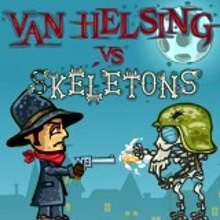
Van Helsing Vs Skeletons 2 throws you into a weirdly satisfying problem: skeletons have shown up, they look far too confident, and the only reasonable response is to fire skulls at them until the whole scene collapses like a haunted stage prop. This is a physics puzzle shooter, not a run-and-gun, and that distinction matters. You’re not winning by speed. You’re winning by reading the level like it’s a trap waiting to be triggered… because it is.
Each stage is a small construction of arrogance. Skeletons perch on platforms, hide behind blocks, or cling to structures that look stable until you touch the right spot. Your ammo is limited, which turns every shot into a decision. Do you go for the direct hit, the clean “bonk” that deletes a target instantly, or do you aim for a support beam and let gravity do the dirty work? The best moments in this game aren’t loud. They’re smart. A single skull hits a weak point, the tower wobbles, something slides, and suddenly the skeleton you couldn’t reach gets crushed by its own safety plan. You didn’t just shoot. You set off a chain reaction. That’s the flavor.
🧠🎯 AIMING IS EASY UNTIL YOU START CARING
At first, you’ll fling skulls like you’re testing the laws of the universe. Cool, it bounces. Cool, it breaks stuff. Then a level shows up where one skeleton survives, tucked into a corner like it paid rent there. You’ll take a shot, miss by a pixel, and watch your skull roll away with the casual disrespect of a ball that knows you can’t catch it. And that’s when you start caring. Suddenly you’re leaning forward, adjusting angles like an engineer with a grudge, and thinking, okay… if I hit that edge, it should ricochet into the support, which should drop the slab, which should push the crate, which should finally knock that smug skeleton out. And the scary part? It works. Sometimes. When you time it right.
The game’s physics feel playful but consistent. You can learn how things move, how blocks tip, how objects roll and bounce, and how a tiny change in angle creates a totally different outcome. That’s why it’s addictive on Kiz10: you’re not grinding stats or waiting for upgrades. You’re improving your brain. Your aim becomes calmer, your shots become more intentional, and your solutions become cleaner.
💀🧩 SKULLS, STRUCTURES, AND THE ART OF “ONE SHOT, PLEASE”
The skull projectile is the star. It’s not just ammo, it’s a tool with personality. It can smash, it can bounce, it can slip into spaces, and it can trigger disasters if you hit the right spot. You’ll start noticing that not every level wants the same approach. Some levels beg for a direct hit, a quick elimination before the structure absorbs the impact. Other levels want you to ignore the skeleton entirely and focus on the building around it. The skeleton is the symptom. The structure is the disease.
That shift in thinking is where the game gets fun in a sneaky way. You stop looking for targets and start looking for weaknesses. Which block is carrying the weight? Which platform is balancing on a tiny edge? Where will an object fall if you break one support? Can you make something roll? Can you cause a domino effect with a single bounce? You’ll feel like a cartoon villain, except your villainy is weirdly tidy. Efficient chaos. Minimal effort, maximum collapse 😌💥
🕯️👀 WHEN THE LEVEL LOOKS SIMPLE, IT’S PROBABLY LYING
One of the funniest parts of Van Helsing Vs Skeletons 2 is how levels pretend to be easy. You’ll see two skeletons on a platform and think, nice, I’ll just tap them out. Then the platform is reinforced, your skull bounces off in the least helpful direction, and the skeletons remain standing like they’re judging your technique. Or you’ll see a big structure and assume you need brute force, but the real solution is one tiny shot that breaks a small connector and drops the whole thing like a curtain.
That’s why it’s worth taking a breath before you shoot. Not a long breath. Just a short pause. Look at the angles. Look at what can roll. Look at what can fall. The game rewards players who wait one second to understand the setup instead of firing immediately. It’s the difference between “I hope this works” and “I know what will happen.” And yes, the second one feels incredible.
😅🪵 FAILING IS PART OF THE FUN, BECAUSE IT’S ALWAYS CLOSE
When you fail here, it rarely feels hopeless. It feels one adjustment away. You almost had it. The skull landed slightly wrong. The block fell the wrong way. The skeleton survived because it got protected by a plank like it had plot armor. It’s annoying, but it’s also funny, because the physics create these little slapstick moments where the universe just barely refuses to cooperate.
And then you restart, because of course you do. The level is short, the retry is quick, and your brain is already rewriting the plan. This is the best kind of puzzle loop: fast feedback, clear cause-and-effect, and that constant sense that you’re learning something even when you’re messing up.
⚡🧠 PLAY LIKE A HUNTER, NOT LIKE A CANNON
If you want to feel smoother, treat each skull like it costs you pride. Don’t waste it. Aim for supports and edges, not just faces. If there’s a tall structure, look for the single point holding it together. If a skeleton is hiding behind blocks, don’t fight the blocks head-on. Make the blocks move. Create a collapse. Make the environment betray the skeleton.
Also, remember that bounces aren’t random. A lot of solutions come from controlled ricochets. If you can learn how your skull rebounds off surfaces, you can thread shots into places that look impossible. And if a level is built around a narrow gap, don’t force power. Use precision. A softer, cleaner shot can land inside a pocket where a hard shot would just bounce away like a mistake.
🎮🦇 WHY IT FEELS RIGHT ON KIZ10
Van Helsing Vs Skeletons 2 fits perfectly as a quick-play, high-satisfaction physics shooter. You jump in, solve a few levels, feel clever, and suddenly you’ve been playing longer than you planned because you keep chasing that perfect clear. Not just winning, but winning elegantly. The game makes destruction feel earned, not automatic. It’s puzzle-solving with a grim little grin, and it’s the kind of experience that stays fun because every level is a new arrangement of angles, weight, and bad skeleton decisions.
If you love physics puzzle games, projectile aiming, chain reactions, and that sweet moment when one shot causes the entire scene to collapse like a haunted Jenga tower, this is exactly your vibe. And yes… the skeletons will keep looking smug until you prove them wrong. So prove them wrong. 💀🔥





 Share
Share
 Embed
Embed