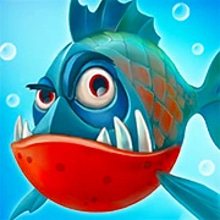
Aqwar.io is the kind of multiplayer game that drops you into the ocean and immediately makes one thing clear: nobody here is safe for long. Kiz10’s page describes it in the bluntest possible way, and honestly that is perfect for this kind of game — fish either get fed or get dead. The underwater world is beautiful, yes, but also full of predators, hidden danger, and exactly the sort of constant threat that makes .io survival games so addictive.
What makes Aqwar.io stand out is that it is not just another quiet fish growth game where you drift around and wait for numbers to rise. Public descriptions of the game consistently present it as a team-based ocean battle experience and a next-generation successor to Oceanar.io, where you start as a small queen fish and gradually build a dangerous school around you. That changes the whole rhythm of the game. You are not only trying to survive as one vulnerable creature. You are trying to build something larger, something more threatening, something that can turn the ocean from a death trap into your territory.
That progression is exactly why the game works. You begin tiny, which means every shadow in the water feels personal. Bigger creatures matter. Routes matter. Safe food sources matter. Then, little by little, your school begins to grow, and suddenly the same ocean that felt impossible a minute ago starts looking readable. Still dangerous, of course. Always dangerous. But readable. That is the magic of a game like Aqwar.io. It turns fear into ambition.
The team-school mechanic gives the game a much stronger identity than a plain “eat and grow” formula. Public descriptions explain that some ocean creatures will gladly join your school while others remain hostile, which creates a more strategic kind of survival. You are not only farming size. You are assembling pressure. Every fish that joins you changes how the battlefield feels. More bodies means more confidence. More confidence means riskier paths, tougher fights, and the dangerous belief that maybe you can start hunting instead of hiding.
That shift is where the game gets properly addictive. The first phase is survival. The second phase is momentum. Once your school starts moving as a real threat, the whole experience becomes much more aggressive. Suddenly you are not only dodging predators. You are looking for weaker targets, better routes, and opportunities to expand faster than the players around you. The ocean stops being scenery and becomes a war map.
And that is the beauty of multiplayer underwater games. The water is open, but it never feels calm for long. Every other player is a potential problem. Every cluster of fish is either an opportunity or a trap. Every chase can go wrong if something bigger joins the scene. Aqwar.io thrives on that uncertainty. It makes the ocean feel alive not because of pretty visuals alone, but because every movement in the water might matter.
Kiz10’s own description reinforces the survival tone really well by emphasizing sharks, predators, shipwrecks, and the need to be both swift and smart. That last part is important. Aqwar.io is not only about being larger. It is also about positioning and judgment. Bigger schools can still make bad decisions. A greedy chase can break your advantage. A bad route can leave you exposed. In games like this, smart movement is often worth more than reckless size.
That is why the best runs feel so satisfying. You are not only surviving because you got lucky. You are surviving because you read the water correctly. You know when to farm. When to flee. When to circle back. When to commit. Those are the decisions that make .io games memorable, and Aqwar.io has exactly the right setup for them. A school of fish is a perfect visual expression of momentum. It lets players feel their progress instantly.
There is also something very entertaining about the ocean setting itself. Sea-based .io games naturally feel more primal than many land arenas. Predators, swarms, shipwrecks, hidden danger behind rocks and coral — the whole environment already feels like it wants to turn every mistake into lunch. That gives Aqwar.io extra tension even before the multiplayer layer kicks in. Once other players and hostile creatures are moving through that same space, the whole thing starts feeling like a constant little food-chain emergency.
Aqwar.io on Kiz10 is a strong fit for players who enjoy .io games, ocean survival, grow-and-dominate loops, and multiplayer action where early fragility slowly turns into real power. Kiz10 confirms the title and its survival idea very clearly, while external descriptions support the team-based fish-school concept and the Oceanar-style evolution of the gameplay.
So yes, Aqwar.io is exactly the sort of game that should feel dangerous, fast, and just a little ruthless. Start small, build your school, avoid becoming food, and slowly turn the whole ocean into a places where other fish start worrying when they see you coming.



 2.5 (60 votes)
 Share
Share
 Embed
Embed