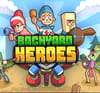
🧒🧒🧒 Three kids, one messy street, zero patience for bullies
Backyard Heroes has that perfect “this should be simple” setup that instantly turns into a mini battlefield the moment you start playing. You’re not a lone superhero with infinite health. You’re in charge of a small squad of kids trying to take back their neighborhood, and the game treats every alley, sidewalk, and backyard corner like it’s a strategic problem waiting to embarrass you. On Kiz10 it feels like a quick, tight strategy action experience: fights happen fast, mistakes show up even faster, and your best weapon isn’t rage… it’s control.
The charm hits right away because the cast is small but purposeful. Each hero has a role, and the game expects you to actually use those roles instead of mashing forward like it’s a brawler with no consequences. You’ve got a healer to keep the team alive, a ranged attacker to poke and punish from safer angles, and a defender who exists for one sacred job: stop the chaos from reaching your softest teammate. Sounds easy. Then the first real group of bullies rushes your formation and you realize “easy” was just the loading screen lying to you 😅
🩹 The healer isn’t optional, it’s your emergency brake
The healer in Backyard Heroes is the quiet MVP. At first you might treat healing like something you do only when health bars look scary. That’s the rookie mistake. The smarter rhythm is to keep your squad topped up so you don’t get forced into panic decisions mid-fight. Because once a character goes down or gets cornered, the battle becomes a scramble, and scrambles are where your strategy evaporates.
What’s fun is how this changes your mindset. You stop thinking like “attack, attack, attack” and start thinking like “how do I keep this little machine running.” Healing becomes tempo control. It buys time for your ranged hero to do damage safely. It lets your defender hold the front line without collapsing. It keeps you from having to retreat at the worst possible moment, with enemies sniffing your ankles.
🎯 Ranged damage feels like cheating… until you aim badly
The ranged hero is where you get that satisfying “I’m doing smart tactics” feeling. Hitting enemies from a distance is great. Watching them get worn down before they touch your team is even better. But the game won’t let you relax with it. If your positioning is sloppy, your ranged unit can get rushed and trapped. If you get greedy and push too far, you’ll suddenly be protecting your attacker instead of using them to control the fight.
The good runs are the ones where you treat ranged attacks like pressure, not like a reckless invitation to chase. You pick targets. You soften the biggest threat first. You keep the ranged hero behind the defender, using space like it matters. Because in this game, space is basically armor.
🛡️ The defender is your wall, your bait, and your problem solver
Then there’s the defender, the character that turns messy street fights into something you can actually manage. A good defender placement makes everything feel smooth. Enemies cluster where you want them. Your ranged hero gets clean shots. Your healer isn’t constantly screaming internally. A bad defender placement, though? That’s how you get the classic disaster scene: enemies flood past the front line, the healer gets hit, the ranged hero panics, and you’re suddenly making decisions that look like you’re playing with your elbows.
The defender isn’t just a shield. They’re also bait. You can pull enemy attention, control movement, and create those precious moments where your team gets to act instead of react. When you start using the defender proactively, the whole game becomes more tactical and less frantic.
⚡ Tiny fights that turn into “wait, why is this so intense”
Backyard Heroes works because battles feel compact but meaningful. You’re not grinding for hours in a long campaign while nothing changes. Each fight is a quick test of whether you’re paying attention. If you win cleanly, you feel clever. If you win barely, you feel lucky. If you lose, you usually know exactly why, and that clarity is dangerous because it makes you want to restart immediately to fix it.
It also nails that neighborhood-war vibe. The stakes aren’t world-ending, but they feel personal. It’s your street. Your backyard. Your space. The enemies are bullies, not monsters, yet they still manage to create the same strategic pressure as a bigger war game because they swarm, punish bad positioning, and force you to manage your team like a real unit.
🧠 The real gameplay is managing attention, not clicking fast
A lot of people approach strategy games like they’re about speed. Backyard Heroes is more about attention. You’re constantly scanning: who’s getting targeted, which hero is low, which bully is the biggest threat, where your formation is leaking, whether your healer is safe, whether your ranged hero is about to get rushed. It’s a juggling act, but it’s the satisfying kind because every small improvement makes you feel stronger.
There’s also that subtle “don’t tunnel vision” lesson. If you focus too hard on attacking, your healer falls behind. If you focus too hard on healing, enemies overwhelm you. If you stare at one lane of the fight, the other side quietly breaks your formation. The best moments happen when you’re calm enough to see the whole scene, like a director watching a chaotic action sequence and making tiny edits to keep it under control.
🏘️ The neighborhood becomes a tactical map in your head
After a while, you stop seeing the environment as just background art. You start seeing it as a map. Corners become choke points. Open lanes become danger zones. Small spaces become places to trap enemies. That’s when the game gets really fun because you’re not just responding, you’re planning.
You’ll have runs where you pull enemies into a tight cluster, hold them with your defender, heal through the damage, and let your ranged hero dismantle the whole group like it was inevitable. And you’ll feel ridiculously proud, like you just won a tournament match using teamwork and brain cells. Then you’ll do the same thing again and mess it up by stepping one inch too far forward, because humility is part of the experience 😅
🎬 It feels like a cartoon episode, but your decisions are the script
The pacing has this cinematic cartoon energy: a calm moment, then a sudden rush of trouble, then a scramble, then a comeback. And your squad dynamics create little stories on their own. The healer saving the team at the last second. The defender holding the line while everyone else does the real damage. The ranged hero picking off the last bully like it’s a punchline. It’s a small cast, but it creates a lot of personality through gameplay.
And because it’s on Kiz10, it’s easy to hop in for a quick session. Backyard Heroes is the type of game you click thinking “I’ll try one fight,” and then you’re still there because you want a cleaner win. Less damage taken. Better spacing. Smoother control. It becomes a quiet obsession, not because it’s huge, but because it’s tight.
🏁 Why you’ll replay: the “I can do that smarter” feeling
The strongest hook is that the game rarely feels random. When you lose, it usually feels like a real tactical mistake. You overextended. You let the healer get exposed. You didn’t manage the front line. You tried to brute force when you should’ve stabilized. That kind of feedback makes you want to come back immediately, because the fix is in your hands, not in some grindy upgrade menu.
If you like strategy games with squads, quick tactical fights, and that satisfying balance of action and planning, Backyard Heroes is a solid pick on Kiz10. It’s simple enough to jump into, sharp enough to punish lazy play, and chaotic enough to keep you smiling while you barely hold the line. Three kids, one neighborhood, and a whole lot of bullies who are about to learn what teamwork feels like. 😈🏘️








 4 (10 votes)
 Share
Share
 Embed
Embed