🩸🖐️ A stupidly simple challenge that turns your brain into a metronome
Chop Hand is one of those games that explains itself in a single glance and still manages to make your palms sweat. There’s a blade. There’s a hand. There’s money sitting there like bait. And there’s that awful little pause before you commit, the moment where you know the only thing between “profit” and “pain” is your timing. On Kiz10, it’s pure skill-game energy: fast sessions, instant feedback, and the kind of tension that lives in half-seconds. The rules are basic, almost rude in their simplicity, but the feeling is sharp. You’re not solving a puzzle slowly. You’re reading rhythm, snapping decisions, and trying to stay calm while your instincts scream “grab it now!”
At first you’ll act brave. You’ll reach quickly, pull back quickly, and think you’ve got it. Then the blade drops and you realize the game isn’t impressed by confidence. It’s impressed by precision. Chop Hand doesn’t care if you “meant” to pull back. It only cares if you did. That’s what makes it addictive: the moment you lose, you immediately know why. And because you know why, you also know it’s fixable. One cleaner move. One calmer reach. One less greedy grab. That’s all. Easy, right? Yeah… sure.
💸⏱️ The money is the bait, the rhythm is the real enemy
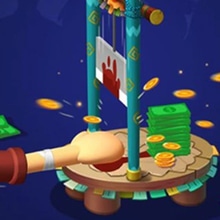
The core loop is basically a dare. You watch the guillotine’s pattern, you wait for a safe window, you push your hand toward the cash, and you yank it back before the blade slams down. The money looks harmless, but it’s the trap that makes you rush. Because the moment you start thinking about the reward instead of the timing, your hand movement gets messy. You hesitate. You overreach. You pull back late by a fraction. And that fraction is everything.
What’s fun is how the game teaches you to respect patterns without giving you the comfort of certainty. You’ll start noticing little tells, the pacing, the feel of the drop, the tiny pauses that seem generous until you’re the one risking your hand. You’ll find yourself counting in your head like a person trying to dance to a song they pretend they know. One-two… now. One-two… no, not now. One-two… okay, now. And when you nail it, it feels clean in a way that’s hard to explain. Not loud, not flashy, just satisfying. Like snapping a lock shut.
😵💫🧠 Greed makes you fast, panic makes you sloppy
Chop Hand is secretly a game about self-control. The safe play is to grab when the window is obviously safe. The risky play is to squeeze in an extra grab when you think you can “just make it.” And you will do that risky play. Everyone does. Because the game nudges you into it. You get a few successful grabs, your confidence swells, and suddenly you’re trying to steal time itself. You start reaching earlier, pulling back later, trying to maximize profit like you’re running a tiny criminal business with zero safety regulations.
Then you get chopped and you sit there for a second like… okay. That was deserved. The funny thing is, the blade doesn’t feel random. It feels inevitable. Like the game watched you get greedy and simply collected its payment. That’s the tension that keeps you replaying: you’re constantly negotiating with yourself. “Just one more grab.” “No, play safe.” “Just one more.” The blade doesn’t negotiate. The blade only drops.
🎮🖱️ Simple controls, ruthless consequences
This is the beauty of a timing reflex game: no complicated moves, no memorizing combos, no endless upgrades you don’t care about. Chop Hand lives entirely in that single skill loop. You either move at the right moment or you don’t. You either commit cleanly or you hesitate. It’s the kind of control scheme that feels instantly natural, which makes the difficulty feel fair. When you fail, you can’t blame a confusing system. You can only blame the decision you made in that half-second.
And because it’s so clean, improvement is visible. You’ll play for a few minutes and suddenly realize your hands are calmer. You’re no longer flinching at every drop. You’re waiting with intention. You’re pulling back faster without panicking. The game turns you into a tiny timing machine, but not in a robotic way. More like a focused, slightly stressed human who learned to respect a blade.
🧊🕯️ The quiet suspense before the drop
There’s a particular atmosphere to guillotine timing games that hits different from normal arcade stuff. It’s not loud chaos, it’s suspense. That tiny moment where everything is still, the blade hovering like a threat, your cursor or finger poised, your brain calculating whether you’re about to be smart or stupid. Chop Hand builds its drama in that silence. The sound of the drop, the sudden snap of consequences, the immediate restart. It’s compact, tense, and weirdly cinematic in a grim little way.
You’ll have rounds where you feel like a pro, sliding in and out with perfect rhythm, grabbing cash like it’s effortless. And then you’ll have a round where you mess up early and your confidence collapses instantly. That’s the emotional swing the game thrives on: calm control versus impulsive greed. It’s basically a mirror held up to your reflexes.
🏁🔥 How to play better without turning it into homework
If you want to last longer, treat every grab like a planned action, not a reaction. Watch the pattern first. Don’t chase money during the “maybe” window. Commit during the “yes” window. Keep your movement clean, in and out, no extra wandering. And when you feel yourself getting excited because you’re on a streak, that’s the exact moment to slow down by a hair. The game loves punishing streak confidence. It waits for the ego, then it drops the blade.
The funniest part is that the best strategy sounds boring: be patient. But when you actually do it, the game becomes smoother, almost satisfying in a zen, slightly terrifying way. You’ll start grabbing money with the calmness of someone who absolutely respects sharp objects. And on Kiz10, Chop Hand is perfect for that quick, intense skill challenge you can replay endlessly because the promise is always the same: you can do better. You can be cleaner. You can be faster. You can be less greedy. Or… you can try to be greedy again and see what happens. 😅🩸



 3.9 (50 votes)
 Share
Share
 Embed
Embed