WELCOME TO THE LITTLE CIRCLE OF PANIC 🎯🌈
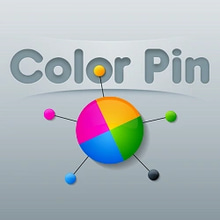
Color Pin looks calm for about half a second. A clean screen, bright colors, a simple target, and that innocent feeling of “oh, this will be easy.” Then you tap once, the pin flies, the timing window snaps shut, and you realize the game isn’t hard because it’s complicated… it’s hard because it’s precise. This is the kind of arcade puzzle game that turns your finger into a tiny judge and jury. One late tap and you don’t just miss, you feel it. You feel the mistake in your stomach like you just tripped in public.
On Kiz10, Color Pin hits that perfect quick-session vibe. No warm-up story, no long menus, no waiting around. You’re in. You’re aiming. You’re tapping. And you’re immediately negotiating with your own patience, because the game keeps asking the same brutal question in different disguises: can you be calm while everything spins?
THE WHOLE GAME IS A SINGLE DECISION (REPEATED FOREVER) 🧠⏱️
At its core, Color Pin is about timing and precision. Tap to launch a colored pin toward the target area, and do it when it makes sense, not when your nerves start shouting. That’s the funny part: your brain will try to rush. It sees an opening and wants to grab it immediately, like a reflex. But openings in this game are slippery. Sometimes the “safe” moment is actually the moment right after the one you wanted. Sometimes you need to wait an extra beat. That extra beat feels like eternity when you’re staring at moving space and imagining your run exploding.
And the game loves that feeling. It thrives on that micro-tension. You start to understand that you’re not playing against a level, you’re playing against your own impulse to tap too soon.
WHEN COLORS START MATTERING (AND YOUR EYES GET LOUD) 👀🎨
Color Pin doesn’t just want you to hit a target. It wants you to read what’s happening. Colors become information. They’re not decoration, they’re signals. You’re watching rotation, spacing, and the way your next pin will fit into the pattern. Sometimes it feels almost soothing, like you’re arranging tiny pieces of a spinning puzzle. Then you blink and realize the puzzle is moving and your hands are sweating over a browser game. Classic.
The more you play, the more you stop staring at your launcher and start staring at gaps. You’ll catch yourself tracking space like a hawk, not the whole circle, just the safe lane you need. It’s oddly satisfying when your eyes lock in and everything else fades out. You’re not thinking in words anymore, you’re thinking in timing. Tap. Pause. Tap. Longer pause. Tap. Then, suddenly, you’re on a streak and you’re acting like you’re performing surgery with your thumb.
THE MOMENT IT GOES WRONG IS ALWAYS FUNNY (AFTER YOU EXHALE) 😅💥
Color Pin has a very specific kind of failure. It’s quick. It’s loud in your head. It’s the “why did I do that” moment. You’ll have a clean run, the pattern looks stable, and then you tap just a fraction too early. The pin collides, the flow breaks, and your brain immediately tries to rewrite history: no, the game lagged. No, the hitbox is weird. No, the circle sped up. But you know. You always know. You got impatient. You wanted the next point too badly.
The good news is that the restart energy is strong. You don’t feel punished for long. The game just tosses you back in like, go on then, prove it. And that’s why it works as stress relief for some players and pure competitive rage for others. Same game, two moods, depending on whether you can laugh at yourself.
WHY IT FEELS ADDICTIVE IN A “ONE MORE TRY” WAY 🔁🔥
There’s something about the simplicity that keeps pulling you back. You’re never far from improvement. You can feel it. You can almost taste it. When you fail, you usually fail by a hair. That makes your brain confident that the next run will be different. Cleaner. Smarter. More controlled. And sometimes it is. You’ll hit a streak where every tap lands like it was pre-planned, and you’ll get that warm, smug feeling of “I’m locked in.” Then the game changes the rhythm slightly and reminds you that confidence is not the same thing as discipline.
Color Pin also has that arcade-style escalation where it asks more from you over time. The spacing gets tighter, the safe moments feel shorter, and you’re forced to respect the beat. You can’t just spam taps and hope. Hope is not a strategy here. The strategy is patience with sharp timing, which is basically the most annoying kind of skill to practice… and also the most satisfying when it clicks.
SMALL HABITS THAT SAVE YOUR RUN 🧷✨
If you want to play better, the biggest shift is learning to wait without freezing. There’s a difference between hesitation and patience. Hesitation is fear. Patience is control. Hesitation makes you tap late because you’re unsure. Patience makes you tap late because you chose to. That sounds like the same thing, but it feels completely different while playing.
Another sneaky habit is to stop “chasing the perfect gap” and start “choosing the safest rhythm.” If you always fire the moment a gap appears, you’ll eventually fire into trouble because the pattern is changing. Instead, find a tempo. A repeatable beat. Tap on the beat when the opening aligns with your plan, not when your nerves beg.
And please, be careful with the classic streak mistake: after several perfect shots, players speed up without noticing. The taps get tighter. The waiting gets shorter. It’s like your finger starts celebrating early. That’s when you crash. If you feel yourself rushing, do the simplest fix imaginable: breathe, wait one extra beat, then fire. It’s boring advice, which means it’s probably correct.
THE BEST PART: IT FEELS CLEAN WHEN YOU PLAY CLEAN 🌀✅
When you’re in flow, Color Pin feels smooth. The target spins, the pins land, the spacing stays tidy, and your taps have this confident snap to them. It becomes less like a frantic arcade game and more like a moving pattern you’re composing. Those are the runs you remember. Not because you unlocked some huge thing, but because it felt like your timing was finally sharper than the game’s tricks.
That’s why it belongs on Kiz10. It’s simple, fast, and replayable, with the kind of challenge that doesn’t rely on complicated rules. It relies on you. Your patience. Your rhythm. Your ability to stay calm when the screen is trying to hypnotize you into tapping at the worst time.
SO… WHAT IS COLOR PIN REALLY TESTING? 😈🎯
It’s testing the part of your brain that hates waiting. The part that wants to act immediately. The part that says “now!” when “not yet” would be smarter. And once you accept that, the game becomes weirdly satisfying. You stop fighting the rhythm and start riding it. You become the calm person in the storm, tapping with intention, letting openings come to you instead of lunging at them.
If you like timing games, color-matching reflex challenges, and arcade puzzle gameplay that’s easy to start but hard to perfect, Color Pin is exactly that kind of clean, addictive trouble on Kiz10.com. One tap at a time. One mistake away from disaster. And somehow… that’s the fun. 🌈🧷



 4.1 (25 votes)
 Share
Share
 Embed
Embed