🧩✏️ The Quietest Game That Still Hooks You Hard
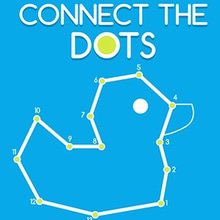
Connect The Dots looks innocent. Like something you’d open for a calm minute, maybe while your brain is still waking up. A blank page, scattered numbered dots, nothing dramatic. Then you draw the first line and something clicks inside your head. Not loudly, not explosively, just a soft little “ohhh.” Because suddenly the mess has direction. The dots aren’t random anymore. They’re a secret drawing waiting to be uncovered, and you’re the only person with the key: the correct order.
On Kiz10, this puzzle game is basically a slow reveal machine. Every correct connection turns confusion into shape. A curve begins to form. A corner appears. A silhouette starts whispering what it might become. You’re not guessing wildly, you’re following a path, and the path feels weirdly satisfying because it’s clean, predictable, and still full of tiny surprises. You think you know what you’re drawing and then the last few lines flip the idea into something else. It’s gentle, but it’s not boring. It’s the kind of calm that keeps you leaning in.
🔢🖱️ Numbers First, Panic Never
The main mechanic is almost comically simple: click the dots in numerical order. That’s the rule. But the experience isn’t “click numbers,” it’s “build an image out of thin air.” You’re tracing a hidden blueprint, one segment at a time, and the game rewards you constantly with progress you can see. There’s no long wait for feedback. The feedback is immediate. A line appears. The outline grows. Your brain relaxes because everything is making sense.
And here’s the funny part: when you miss a number, you feel it instantly. Not because the game screams, but because the rhythm breaks. It’s like skipping a beat in a song. You’ll hesitate for a second, glance around, find the next dot, and continue. The game stays friendly, but it still expects attention. That’s why it works so well as a “focus reset” game. It’s easy to start, but it gently demands that you stay present.
🧠🌈 Your Brain Loves Patterns More Than You Think
Connect The Dots is secretly a brain-comfort game. Humans love turning chaos into order. The scattered points look like noise, and your mind wants to turn noise into meaning. Every line you draw is a tiny act of control. You’re organizing a space. You’re building structure. You’re watching a picture emerge from nothing but instructions and your own patience.
The best part is the moment the image becomes recognizable. That halfway point where you suddenly go, oh, it’s a fish. Or a car. Or a face. Or something cute. That recognition hits like a tiny reward, and it motivates you to finish because now you want the complete reveal. Not “I should finish,” but “I need to see the full thing.” That’s the hook. It’s clean curiosity.
🧵✨ The Reveal Feels Like Magic, Even When It’s Just Lines
A good connect-the-dots puzzle has pacing. Early connections feel simple, like the game is warming you up. Then the dots start forming tighter curves, longer arcs, little details that make the image feel more intentional. You’ll find yourself tracing a delicate outline and thinking, okay, this is actually pretty. The lines are doing something your eyes respect.
And once the last dot is connected, the image feels earned. Not because it was hard in a punishing way, but because you stayed with it. You completed the path. You didn’t quit halfway when it was still just a mess of dots. That final moment has the same satisfaction as finishing a neat drawing or completing a small puzzle book page. It’s simple joy. The kind you don’t need to justify.
😅🧭 The “Where Is The Next Number?” Mini Drama
Even in a relaxing game, there are tiny stress moments. The classic one is when you’re looking for the next dot and your eyes refuse to find it. You know it’s there. The page isn’t that big. But your brain briefly becomes a confused owl. You scan left, scan right, and suddenly you spot the number tucked near a cluster and you feel slightly offended. Like it was hiding on purpose. Then you keep going, and the calm returns.
That little “search moment” is actually part of the fun. It adds a light puzzle layer beyond pure order-following. You’re not only connecting, you’re also visually tracking and locating. It keeps your attention engaged without turning the game into something stressful.
🎨🧒 Cozy Puzzle Energy, But Still Rewarding for Everyone
Connect The Dots is often seen as a kids game, but the appeal isn’t limited to kids. Adults play it for the same reason they play satisfying puzzle games: it’s relaxing and it delivers progress constantly. It doesn’t punish you with complicated systems. It doesn’t demand fast reflexes. It just invites you into a calm loop: connect, reveal, complete, move on.
On Kiz10, it fits perfectly as a quick session game. You can do one drawing and leave. Or you can keep going because finishing one picture makes you curious about the next. Each new layout is a fresh mystery, and mysteries are hard to ignore when they’re this gentle. It becomes a little collection of calm wins.
🧩✨ Small Tips That Make It Feel Even Better
If you want smoother puzzles, keep your eyes one step ahead. Don’t only look for the next dot, look for where the line is trending. Curves usually hint at the next direction. Clusters of dots often mean detail is coming. If you loses the next number, scan around the last dot you clicked first, because puzzles often keep nearby progression before jumping across the page.
And if you’re playing for pure relaxation, don’t rush. This is one of those games where slow feels right. The drawing doesn’t run away. The reward is the reveal. Let it unfold.
Connect The Dots on Kiz10 is exactly what it promises: a clean, satisfying puzzle drawing game where numbered dots turn into pictures, and pictures turn into that quiet “nice” feeling you didn’t realize you needed. Simple concept, surprisingly sticky, and perfect for anyone who enjoys turning disorder into something recognizable. ✏️🧩🙂





 Share
Share
 Embed
Embed


