💎🧨 The first diamond feels like a gift, then the sky starts throwing bricks
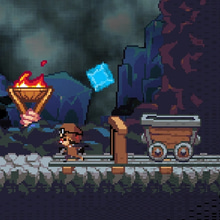
Diamond Hunter on Kiz10.com is the kind of arcade game that smiles politely and then immediately tests your reflexes like it’s offended by your confidence. You spawn into a simple-looking arena with one clear promise: collect diamonds, stay alive, score big. Easy, right? Then the hazards begin falling, rolling, exploding, and generally behaving like they were designed by someone who hates calm moments. Suddenly you’re not “playing casually,” you’re weaving through danger, snatching diamonds like they’re oxygen, and trying to keep your head clear enough to remember the most important part: you don’t just collect gems… you have to deliver them to the cart to actually bank the score.
That delivery twist is what turns Diamond Hunter from a basic dodge game into a real decision-maker. You can survive by playing cautious, sure. But you’ll never score high if you don’t take risks, grab a handful of diamonds, and commit to the cart run while the screen is still hostile. It’s a survival loop with a greedy heartbeat. The game isn’t asking “can you live?” It’s asking “can you live while being ambitious?” 😅
🧠⚡ The real enemy is not the rock, it’s your timing
At the center of Diamond Hunter is a very simple skill: knowing when to move and when to freeze. A lot of players lose because they panic-walk constantly, drifting into danger they could have avoided by holding position for half a second. This game rewards calm micro-movement. Tiny sidesteps. Quick adjustments. Short bursts to escape an incoming threat. Then stillness again, just long enough to let the next hazard land harmlessly nearby.
And here’s the funny part: the more you survive, the more your brain starts seeing patterns in the chaos. You’ll notice how objects fall and bounce. You’ll start predicting where danger will end up after the first impact. You’ll stop reacting late and start planning early. That’s when the game becomes addictive, because you can feel improvement in your hands, not in a menu. One run you’re scrambling. Next run you’re gliding between hazards like you’ve learned the language of the arena.
🛒💎 Banking diamonds is the moment where courage gets tested
Collecting diamonds is satisfying, but it’s also a trap. When you have a pocketful of gems, your whole mood changes. You start moving differently, more urgently, because now you’ve got something to lose. The cart becomes your safe deposit box, and every second you’re not dumping diamonds into it feels like you’re carrying a bag of gold through a storm.
This is where Diamond Hunter becomes a game of routes. You can’t just run to the cart whenever you feel like it. You need a window. You need a path. You need a moment where the falling hazards leave you a lane, and you commit. That commitment is thrilling because it’s never perfectly safe. Even a “clean” run can turn messy if a rock bounces wrong or a bomb lands in the wrong place. So you learn to keep your cart runs short and purposeful. Grab a few diamonds, bank them, reset. Or, if you’re feeling brave (or reckless), grab a lot, bank them late, and pray the arena doesn’t decide to punish greed. Spoiler: it loves punishing greed 😭
🪨💥 Rocks, bombs, and the art of reading danger like weather
The hazards in Diamond Hunter aren’t just background noise. They shape your movement. A falling object isn’t dangerous only when it drops, it’s dangerous where it ends up. Some hazards can block space and turn the arena into a maze. Others create sudden “no-go zones” that force you to reroute. The tension comes from dealing with multiple threats at once: something falling now, something rolling across your lane, and something else waiting to punish you if you hesitate.
The best way to survive is to keep a mental map of “escape space.” Always know where your nearest safe patch is. Always keep one lane open. If you drift into a corner without an exit, you’re basically signing up for a bad surprise. The game rewards players who play wide, who keep options, who don’t trap themselves chasing one diamond in a dangerous pocket. It’s a simple survival rule that becomes more valuable the longer you last.
😈💰 Score-chasing turns you into a tiny villain
Here’s what Diamond Hunter does to you psychologically: it turns you into a score addict. You start by trying to survive. Then you start trying to survive with more diamonds. Then you start trying to survive while banking diamonds faster. Then you start taking risks on purpose because you want a bigger score jump. You’ll see a cluster of diamonds in a risky zone and your brain will whisper, you can get those. And sometimes you can. When you pull it off, you feel brilliant, like you just robbed the arena and escaped. When you fail, it’s dramatic and immediate, the kind of failure where you sit back and think… why did I do that? I was fine. I was winning. I got greedy. Again.
But that’s why the game works. Greed creates stakes. Banking diamonds creates tension. And the combination creates replay value that hits hard on Kiz10.com, because you’re always one better run away from a new personal best. The game doesn’t need a story. Your story is your score and the chaos you survived to earn it.
🎮🌀 The flow state is real, and it’s weirdly satisfying
When you’re playing well, Diamond Hunter enters this hypnotic rhythm. You dodge, you collect, you bank, you reset, you repeat. Your eyes start scanning the top of the screen for incoming threats while your hands handle micro-movement almost automatically. You stop thinking in full sentences. You think in impulses: left, pause, right, cart, back. That’s the arcade flow state, and it’s the best part of the game. It feels like control inside chaos, like you’re dancing in a storm and somehow staying dry.
And then the game spikes the pressure again, because it always does. A rough hazard sequence appears, the arena closes in, and now you have to prove your flow is real skill, not luck. Those are the moments where you’ll either break or level up. If you survive a nasty sequence and still bank diamonds afterward, it feels amazing. Not loud-amazing, more like a quiet grin: yeah, okay, I’m getting good at this 😎
🔁🏆 Why “one more run” is basically guaranteed
Diamond Hunter is built for short, intense runs with instant learning. You die and you know why. You moved too early. You ran to the cart at the wrong time. You got greedy with a diamond cluster. You trapped yourself in a corner. That clarity is dangerous because it makes you restart immediately. You don’t feel helpless. You feel challenged. And a challenge that feels solvable is the most addictive kind.
If you like arcade survival games, dodge-and-collect mechanics, and score attack loops where risk equals reward, Diamond Hunter is a perfect fit. It’s simple enough to jump in instantly, but sharp enough to keep you improving. Play it on Kiz10.com, keep your movement clean, bank diamonds often, and remember the rule the arenas never stops enforcing: the cart doesn’t care how many diamonds you grabbed… only how many you actually delivered. 💎🛒



 4.3 (45 votes)
 Share
Share
 Embed
Embed