🌼⚠️ The Garden Looks Peaceful… Until the Mushrooms Start Marching
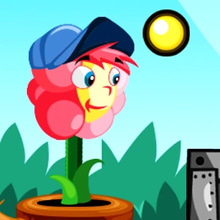
Flower Rush is the kind of game that tricks you with its face. It looks adorable, almost innocent, like a sticker sheet came to life. Then the first enemies appear and suddenly you’re in a fast little defense battle where your tiny flower hero is basically saying: “I may be cute, but I’m not helpless.” On Kiz10, this is an arcade-style defense shooter focused on timing, aim, and that delicious high-score obsession where you tell yourself you’ll stop after one run and then immediately try to beat your own record. The concept is straightforward: defend yourself from incoming enemies, keep them away from your safe space, and rack up as many points as possible.
The vibe is light, but the pace can get sneaky intense. The enemies don’t wait politely. They press in. The moment you relax, you’ll feel it. And that’s what makes Flower Rush fun: it’s simple enough to understand instantly, but it keeps poking your focus like a tiny needle. You’re always calculating one thing: can I land the next hit before they get too close?
🍄🎯 A Barricade, a Projectile, and a Very Personal Grudge
Your flower isn’t running around a huge map. Instead, the game leans into defense positioning: you’ve got a protective setup (a barricade vibe) and you’re dealing with a steady stream of threats. Think of it like a micro fortress defense, except your fortress is basically plant bravery in its purest form. The enemies (often shown as nasty mushrooms in versions of this game concept) move toward you, and you respond the only way a heroic flower can: by throwing projectiles with precision.
The best part is how quickly you start caring about the throw trajectory. At first you’ll just fire because “enemy = shoot.” Then you notice the timing windows. You see how spacing matters. You realize a clean hit early is worth more than a frantic hit late, because late hits often happen when you’re already under pressure. Suddenly you’re not just defending, you’re controlling tempo. It’s small-scale strategy hidden inside arcade chaos.
⚡🧠 Trajectory Brain: You Don’t Need Math, But You’ll Start Doing It Anyway
Flower Rush rewards that satisfying middle ground between reflex and planning. You don’t have to solve complicated puzzles, but you do have to aim with intention. The throw arc matters. Distance matters. Enemies don’t stand still. So you start making micro-adjustments: a little higher, a little earlier, a little lower, a little faster. And once your brain locks into that rhythm, the game becomes weirdly hypnotic.
There’s also a psychological trick here: you’ll miss a shot, and your instinct will be to shoot faster to “make up for it.” That’s usually how the run collapses. The better approach is calmer: fix the timing, not the panic. The game feels at its best when you’re firing with confidence, not spamming like you’re swatting flies.
🌿🔥 The Score Chase That Turns One Minute Into Ten
Because Flower Rush tracks your last score and your personal best, the game basically dares you to return. That little record number is a magnet for stubborn players. Your first run will be messy and you’ll accept it. Your second run will be better and you’ll feel proud. Your third run will be worse because you got greedy. Then you’ll have that one run where everything clicks and you’re landing hits clean, keeping enemies at the perfect distance, and your score climbs like it’s finally listening to you.
And the moment you beat your personal best, you get a tiny rush of victory… followed by the dangerous thought: “I can beat that too.” That’s where Flower Rush becomes an endless loop. It’s not long, it doesn’t need to be. It’s built around short attempts that get sharper over time. Perfect Kiz10 energy: quick to start, hard to put down.
🧩🌸 Difficulty That Feels Like Pressure, Not Punishment
Good arcade defense games don’t need huge complexity to feel challenging. They just need pressure. Flower Rush does this by keeping the incoming threat consistent enough to learn, then intense enough to demand focus. As your score climbs, you’ll often feel like the game is asking more from you: cleaner aiming, faster reactions, fewer wasted shots. It never has to scream “hard mode” at you. It simply increases the consequence of sloppy play.
The nice part is that failure doesn’t feel unfair. When you lose control, you usually know why. You shot too late. You missed a key enemy. You hesitated for half a second. It’s the kind of game where improvement is honest. That honesty makes it replayable, because you don’t feel stuck behind randomness. You feel like you can get better.
😅🌈 The Mood: Cute Violence, Basically
Let’s not pretend: it’s funny. You’re a flower defending yourself from evil little enemies and somehow it feels heroic. The cuteness makes the tension more playful. When you’re doing well, you feel unstoppable in a silly way. When you mess up, you’re not angry in a serious “I lost hours” way, you’re more like: “Okay, the mushrooms got me. Respect. Rematch.” That’s the charm.
It’s also a great game if you like quick browser action without long tutorials. You can hand it to someone and they’ll understand it instantly: defend, aim, hit, survive, score. The simplicity is the doorway; the score chase is the trap.
🎮🌼 Why Flower Rush Works So Well on Kiz10
Flower Rush is proof that a small idea can carry a whole game when the feel is right. Cute character, clear threat, satisfying projectile aiming, and a high-score loop that keeps pulling you back. It’s an arcade defense game you can play in short bursts, and it rewards the kind of player who likes tightening their timing little by little until a run feels clean. If you want a fast, friendly, skill-based defense shooter that lives on aim, rhythm, and stubborn “one more try” energy, Flower Rush on Kiz10 is exactly that.


















 4.1 (23 votes)
 Share
Share
 Embed
Embed