🍽️ A Street That Starts Empty and Ends Up Loud 🍽️
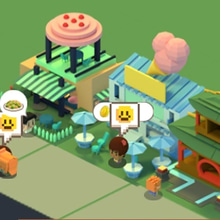
Foody Avenue begins with a simple idea that feels harmless: there’s an avenue with space for food businesses, and you’re the one who gets to shape it. Not as a chef flipping one burger at a time, but as the person behind the whole operation, the one who decides what opens, what gets upgraded, who gets hired, and why the bakery is somehow always running out of ingredients right when the crowd shows up. You click in, you build your first little spot, and for a moment it’s calm. Then customers appear. Then more customers appear. Then you realize your “cute little street project” has turned into a living machine that needs constant attention, like a hungry pet made of capitalism and cupcakes.
This is a simulation game, but it doesn’t feel like staring at numbers in a boring box. It feels like managing momentum. You’re guiding a growing food district where every shop has a role, every upgrade changes the pace, and every delay creates a chain reaction you can practically hear. When one place isn’t stocked, customers hesitate, lines form, money slows down, and your brain starts doing that quiet panicky math: if I upgrade this, can I afford the next one, and will it stop the avalanche? Foody Avenue on Kiz10 is that kind of game. Light on the surface, surprisingly addictive underneath.
🥐 Build First, Then Realize You Built a Problem 🥐
The first few builds are satisfying in a clean way. Place a shop, watch it come alive, see customers walk in like they were waiting around the corner for you to exist. There’s a gentle thrill in watching empty space transform into something functional. But the game’s real charm is how quickly “functional” becomes “complicated.” A single shop is manageable. Two shops are still fine. Three shops start tugging at your attention like children asking different questions at the exact same time. And when you expand further, you stop thinking of each shop as a cute little building and start thinking of it as a station in a production chain that must not collapse.
It’s not stressful in an unfair way. It’s stressful in that playful, motivating way where your mistakes are obvious and fixable. You forgot to stock something? You see it. You fix it. You upgrade. You hire. You learn. The avenue becomes a puzzle made of people, supplies, and timing. And it’s fun because the problem is always your own creation. You built the street. Congratulations. Now keep it from falling apart.
🧑🍳 Hiring Staff and Watching the Avenue Get Smarter 🧑🍳
One of the most satisfying turns in Foody Avenue is when you stop feeling like you’re personally running everywhere. Hiring staff changes the entire mood. Instead of you being the frantic manager doing everything, you become the planner who sets up a system that works even when you’re not micromanaging every step. That’s the point where your avenue starts to feel professional, like it’s evolving from a scrappy street corner hustle into a real business district.
And it’s not just “hire anyone.” You start caring about efficiency. You notice bottlenecks. You notice that one shop gets slammed constantly while another feels underused. You start building a rhythm: keep this place stocked, upgrade that place’s speed, open the next business at the right moment so it adds profit without overloading your attention. The staff aren’t just decoration. They’re the difference between an avenue that survives and an avenue that actually grows.
🍟 Stock, Restock, Repeat, and Try Not to Panic 🍟
If Foody Avenue has a heartbeat, it’s inventory. Everything looks smooth when supplies are full. The moment something runs out, the whole illusion wobbles. Customers don’t want excuses. They want food. They want it now. And the game is constantly tempting you to expand faster than your supply chain can handle, which is honestly very realistic and slightly evil.
This is where the management part shines. You’re not only unlocking new locations and shops; you’re learning how to keep them fed. There’s a small joy in preventing problems before they appear. Stocking at the right time feels like being psychic. Stocking too late feels like watching money leak out of your hands. You’ll have moments where you fix one issue and immediately discover another, like you’re playing whack-a-mole with fries and pastries. But that’s the loop. It keeps you engaged because there’s always a next improvement that makes the whole street run smoother.
🌆 Expanding the Avenue Like It’s a Food Kingdom 🌆
The avenue grows in a way that feels rewarding because it’s visible. You can look at your street and see progress: more buildings, more customers, more movement, more income. The game doesn’t hide its rewards behind complicated menus. It shows you a living avenue that becomes busier and more profitable because you built it that way.
Expansion also changes the decisions you make. Early upgrades are obvious. Later upgrades become strategy. Do you improve a top-earning shop that’s already doing well, or do you rescue a struggling spot that’s slowing the flow? Do you open something new for more income, or tighten the system first so you don’t create chaos you can’t control? These choices are what make Foody Avenue feel like a proper business simulation, even though it stays friendly and easy to jump into.
🍩 New Recipes, New Shops, New Temptations 🍩
As you unlock more content, the avenue starts to feel like a real foodie district, not a single restaurant pretending it’s an empire. New shops and recipes bring variety, and variety is both exciting and dangerous. Exciting because it keeps the game fresh. Dangerous because every new feature is another thing you need to manage. You’ll unlock something and feel proud, then immediately realize you just added another moving part to your system. Great. Love that for you.
But it’s the good kind of complexity. The kind that makes you feel clever when you keep everything running. When your shops are stocked, your staff are active, your upgrades are tuned, and customers keep flowing through smoothly, it feels like you built a tiny city economy out of snacks. That’s a special kind of satisfaction, honestly. It’s calm and chaotic at the same time.
🎯 The “Just One More Upgrade” Trap 🎯
Foody Avenue is dangerously good at making you say, “I’ll stop after this upgrade.” Because upgrades aren’t abstract. You feel them. You see faster service. You see higher earnings. You see smoother flow. The game rewards your improvements quickly, and that quick reward makes the next improvement feel irresistible.
You’ll also start doing that classic tycoon-game thing where you optimize without noticing. You’ll stare at the avenue and think like a manager. This shop needs love. That shop is carrying the team. This area needs expansion. That area needs stability. It becomes a gentle obsession, not because the game forces you, but because it constantly offers you small, satisfying wins.
🎉 Why Foody Avenue Feels So Replayable on Kiz10 🎉
Foody Avenue works because it’s simple to understand but rich in pacing. You can play it casually, making a few upgrades and watching the street grow. Or you can play it like a strategist, pushing efficiency, balancing expansion, and trying to keep everything stocked without a single moment of downtime. Either way, it has that perfect browser-game rhythm: always moving, always improving, always one decision away from either a smooth run or a tiny mess you have to clean up.
If you like restaurant management games, business simulation, and that cozy feeling of building something bigger step by step, Foody Avenue hits the sweet spot. It’s not about being perfect. It’s about growing a food street that actually feels alive. And when your avenue finally clicks, when every shop is running, customers are happy, and income is flowing like a parade of coins, you’ll sit back and think, yeah… I built this. Then you’ll open one more shop anyway, because you can’t help yourself. 🍔✨


















 4 (35 votes)
 Share
Share
 Embed
Embed


