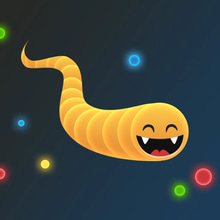
🐍 First seconds, tiny snake, big room The match loads and I’m a little neon noodle trying not to sneeze. There’s space everywhere, dots blinking like candy, and a couple of giant snakes slicing the arena like they own it. I nudge the controls, not a hard turn, just a polite lean, and the head follows as if it’s thinking the same thing I am: stay alive, eat something shiny, don’t blink near the big orange one. Two orbs, five, ten. Length happens slowly and then all at once. The body starts to feel real. A curve holds. A lane opens. I relax my shoulders without meaning to.
⚡ One tap too long, lesson learned Boost is intoxicating the first time. You touch it and the world scoots back. The problem is the second touch, the greedy one. The trail you leave becomes breakfast for anyone smarter than you in that moment, which, honestly, is everyone. So you start treating boost like a spice. A flick to snap a line shut. A whisper to escape a mess. The arena rewards restraint in a way that feels almost adult. I find myself saving a burst for the exit, not the entry, and it pays off more than I want to admit.
🎯 The hunt isn’t food, it’s mistakes The really long snakes don’t chase you; they aim at the places you will want to go next. It’s rude and brilliant. I try it once on a blue rival who’s laser-focused on a fat pile of orbs. I drift away from the feast like I don’t care, then ease my body around the lane they’ll need to escape. They commit. I finish the circle a beat later. It isn’t dramatic. It’s a quiet door closing. They tap boost into a wall of me and pop like a party favor. The scramble that follows is warm chaos—everyone dives for the spill, elbows out, and I get enough to feel taller.
🌈 Movement that turns into handwriting After a few minutes the snake stops feeling like a cursor and starts feeling like a pen. Lines get smoother. I’m drawing S-curves without thinking about them. When a rival flinches, my body writes a tidy ellipse that says nope, not today. The map becomes paper, my color a signature. It’s weirdly personal. Even the camera angle feels like it’s nodding along, showing enough of what’s ahead to plan without killing the thrill of a blind corner. A clean loop around a starburst of fallen orbs feels like signing your name with a good pen on expensive paper. Silly, but true.
🧠 Little reads that keep you alive I start watching heads, not tails. Heads tell the truth. A jitter means panic. A steady arc means trap. When two giants mirror each other near center, I drift to the outskirts and wait because someone is about to blink and spill dinner for the patient. Corners are noisy, the middle is political, and the edges are where introverts like me survive. I practice short exits: collect, quarter turn, slide out along my own tail like it’s a guardrail. It turns out survival is a rhythm you can learn. Tap. Glide. Look. Eat. Repeat.
😼 The polite cruelty of the slow squeeze The best trap is never loud. You leave a lane that looks generous and then shrink it by centimeters. The other player thinks they can still thread it if they try just a bit harder. You breathe. You give them one more loop to hope, and while they’re busy hoping, your circle settles and the click happens. It’s not personal. It’s geometry with manners. If I rush the finish, I bump them and we both explode and someone else gets rich. If I wait, I get the pile and the lesson. Waiting wins more than any sprint.
🎮 Feeling in the fingers, not the HUD Controls are honest here. Mouse, touch, keys—it doesn’t matter as long as I keep movements small. Big swings break shape; tiny nudges carve lanes. I start cutting across my own trail at shallow angles to reset the board, which is a fancy way of saying I take a breath. When I crash, I know why. When I succeed, it’s because a plan survived contact with chaos. That clarity keeps me in the lobby longer than I planned. A browser game shouldn’t feel this tactile, and yet my wrist is doing micro-corrections like I’m balancing a tray through a crowded café.
🌍 Every lobby has a weather report Some rounds are slow storms of giants guarding the center. Others are a rain of sprinters, all boost and bravado, popping like popcorn and feeding a few patient vultures. I like the ones that start quiet and turn mean. Early game I’m a scavenger, mid-game a shepherd nudging folks toward edges, late game a fence builder drawing big circles around impatient ideas. The map doesn’t change, but the people do, and that’s enough to keep the stories new. I can almost hear the mood when the first huge spill happens—the chime changes, the camera gets greedy, and everyone leans forward.
🧩 Micro habits that pay rent Head out, not in, when you harvest a fat cluster so your exit exists. Cut diagonally across the map instead of straight lines; diagonals buy time. If a larger snake shadows you, stop boosting and start turning in small, stubborn squares until their hunger makes them sloppy. When I’m the large snake, I use the edge as a hinge—press a rival toward the border, then close the last gap with a short dash so they run out of angles. None of this is a rulebook. It’s a handful of habits that make panic quieter and choices easier.
🔊 Sounds that don’t shout Orbs tinkle like glass marbles. Eliminations sparkle without gloating. Boost is a breath, not a roar. The mix keeps my eyes doing the important work—reading arcs, spotting tells—while my ears keep time. There’s a particular hush right before I seal a loop, and I swear it makes me hold my own breath. When the pop happens, the music doesn’t spike; the map just exhales and lets the scramble write a new scene.
🌟 The moment you feel big Size sneaks up on you. A minute ago you were threading gaps; now you’re creating them. With length comes responsibility… and mischief. I try herding two smaller snakes toward each other, then feather through the middle to steal what falls. It feels rude but tidy. I also learn how easy it is to overplay it: one greedy squeeze near the center and someone’s tiny head finds my poorly planned exit and smacks it. Lesson accepted. Big doesn’t mean invincible; it means visible. Everyone wants your headline.
🪄 Finesse beats drama My favorite play of the night isn’t a huge trap. It’s a rescue. I’m too deep in the middle, exits closing, and instead of boosting straight, I slide across my own tail at a shallow angle, wait half a beat, then drift out along a lane I didn’t notice until my body drew it. Two players crash behind me and the pile is ridiculous. I don’t even turn back. I just smile and promise to pretend I meant to do that. Clean small decisions feel better than lucky big ones. They also stack.
💬 A little trash talk in my head I don’t type it, but I think it: nice try when someone boosts at my head and eats my corner instead. Or okay, that was fair when a yellow coil corrals me beautifully and I watch my dots rise into their perfect spiral. The game keeps me honest. It’s not about invincibility. It’s about reading. On good runs I’m not faster than other players; I’m just a half-second earlier at the right turn.
🏁 Why another round happens Because progress is visible. You start small and twitchy; a few minutes later you’re drawing steady lines and seeing two turns into the future. Because losing is a note you can fix, not a mystery. Because winning doesn’t look like a number—it looks like a circle that closes exactly when it should and a calm exit while everyone else scrambles. Happy Snakes has that arcade honesty that gets under your skin. One more lobby becomes three, then five, and suddenly you’ve got a favorite route, a favorite speed, a favorite kind of opponent to tease. You close the tab feeling oddly relaxed for a game about eating light. And then, yes, you open it again, just to try that trap you almost landed. This time you land it. And the grin is ridiculous.











 4.4 (67 votes)
 Share
Share
 Embed
Embed