🏁🟦 THE FLAG IS A LIE (UNTIL YOU TOUCH IT)
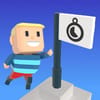
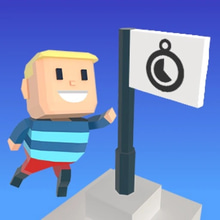
KOGAMA Reach The Flag on Kiz10 looks friendly for about one second. Bright blocks, smooth platforms, a nice little course that basically whispers “just run forward.” And then you take three steps and the game shows its real face: a 3D parkour race where every jump is a tiny contract you sign with gravity, every shortcut is a rumor you heard in your own head, and the flag at the end is sitting there like a smug referee. You don’t “arrive” at the flag. You earn it. Sometimes you earn it with skill. Sometimes you earn it because the person ahead of you face-planted into a wall and you just… kept moving. That still counts. 😅
This isn’t slow exploration. It’s momentum, timing, and that delicious KOGAMA energy where you’re not just running a course, you’re racing a crowd of unpredictable players who have the same idea as you: get to the flag first, no excuses, no handshake, no mercy. You’ll jump. You’ll land. You’ll slide off an edge by one pixel and watch your character fall like a dramatic stunt double. Then you’ll respawn and immediately go again because the run is short, the failure is fast, and the win feels loud. Kiz10 games live for that loop, and this one leans into it with a big grin.
🧠⚡ PARKOUR BRAIN: WHEN YOUR HANDS START THINKING FOR YOU
The funniest thing about Reach The Flag is how quickly you stop playing like a casual person. At first you’re learning: where do I jump, how far can I clear, what’s safe, what’s bait. Then your body starts learning faster than your thoughts. Your fingers commit to jumps before your brain finishes the sentence. You see a gap and your hands go “yes.” You see a corner and your hands go “cut tighter.” You see a moving platform and you suddenly become a timing monk, calm and focused, waiting for the perfect moment like you’re defusing a bomb. 😬
That’s the parkour skill part. It’s not complicated controls, it’s micro-decisions stacked back-to-back. Do I jump now or one step later? Do I aim center or clip the edge to save distance? Do I take the safe route or do I trust the risky line that might shave two seconds? Those choices feel small, but in a race they’re everything. And the game is built around that tension: you can play safe and steady, or you can gamble for speed and risk turning into a falling meme.
What really sells it is the pacing. You’re constantly doing something. Even when you’re “waiting” for a platform, your brain is active. You’re reading the next jump, planning the angle, watching the movement pattern like it’s trying to trick you. When you finally go, it feels like releasing a spring. And if you nail it, you feel unstoppable for exactly long enough to make the next mistake. Perfect.
🧱🔥 THE COURSE DOESN’T HATE YOU… IT’S JUST BUILT LIKE A PRANK
The stages in this style of KOGAMA parkour race usually have a specific personality: they look straightforward, but the lines are deceptive. A platform might be wide enough to land safely, but the edges are slippery in the way that makes you overconfident. A jump might be “easy,” until you take it while someone bumps you midair and your landing becomes a sad little wobble into the void. A ramp might launch you perfectly, or it might turn you into a human projectile that overshoots the next platform and disappears. The game is constantly asking, how clean is your control under pressure?
And pressure is real, because racing changes how you move. When you’re alone, you can breathe, take a jump carefully, reset your angle. When there are other players around, everything feels urgent. Somebody passes you and your brain screams “GO!” and you start rushing. Rushing makes you sloppy. Sloppy makes you fall. Falling makes you angry. Angry makes you rush harder. Congrats, you’ve entered the classic parkour spiral. 😂
The way out is weirdly simple: commit to clean movement. Not slow, not cautious, just clean. Keep your camera steady enough to read the next landing. Stop overcorrecting midair. Don’t spam jumps like you’re trying to impress the laws of physics. If you treat each jump as a clear decision, your runs become smoother, faster, and less chaotic in the bad way. Chaotic in the good way is fine. Chaotic in the “I fell five times in a row on the same gap” way is… not it.
🚀😈 SHORTCUTS, COLLISIONS, AND THE ART OF BEING JUST A LITTLE MEAN
Let’s be honest. In multiplayer parkour racing, there’s always a little bit of villain energy. Not full evil, just… competitive spice. You’re shoulder-to-shoulder on a narrow platform and someone nudges you off. Was it intentional? Maybe. Was it personal? Your brain will decide it was. Then you respawn and vow revenge, and suddenly the race has a storyline that exists only in your heart. That’s the magic of these games. The course is the same, but the drama is always new.
Shortcuts are where the real identity of a “Reach The Flag” course shows itself. There are usually safer paths and faster paths. The safe path is consistent. The fast path is a gamble. And your mood decides which one you choose. Feeling calm? You take the steady line and let other players implode. Feeling spicy? You take the risky jump that might skip a whole section. If it works, you feel like a parkour genius. If it fails, you lose time, respawn, and immediately lies to yourself: “I can still win.” 😅
The best part is when you start learning “your route.” Not the official route, your route. The one where you cut corners, take a weird angle, jump earlier than you should, and somehow it flows. That’s when the game becomes addictive, because you’re no longer just trying to reach the flag, you’re trying to reach the flag your way. Faster, cleaner, cooler. Even if nobody notices. You notice. That’s enough.
🎮✨ HOW TO PLAY LIKE YOU MEAN IT (WITHOUT LOSING YOUR MIND)
If you want to improve quickly, focus on two things: consistency and recovery. Consistency means you pick jumps you can hit repeatedly, not just once when the universe is feeling generous. Recovery means when you mess up, you don’t panic. You reset your angle, you take the next clean step, you rebuild momentum. The worst mistakes in this game happen after the first mistake, because your brain starts rushing to “make up time” and you end up stacking errors like a tragic domino show.
A good habit is scanning one platform ahead. Not five platforms ahead, just one. Keep your eyes on the next landing, not the flag. The flag is a distraction, like a shiny object trying to bait you into sloppy movement. You reach the flag by winning the next jump, then the next, then the next. And when you finally hit that last platform and slap the goal, it feels like a tiny explosion of relief. Your hands unclench. Your shoulders drop. You didn’t just win a race, you survived your own impatience. 🏆
KOGAMA Reach The Flag on Kiz10 is perfect if you like 3D parkour, obstacle courses, speedrun vibes, and that competitive multiplayer feeling where every second matters and every jump has consequences. It’s quick, chaotic, and weirdly personal, because the flag isn’t just the finish line. It’s proof you kept your cool while everything tried to knock you off the map. 🏁🧱⚡








 4.6 (35 votes)
 Share
Share
 Embed
Embed