👆🔴 ONE BUTTON, ONE FINGER, ZERO MERCY
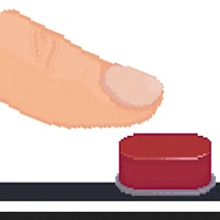
One Button One Finger looks like a joke title until you play it and realize it’s basically a tiny stress test for your timing, your patience, and your ability to not overthink something that takes one tap. That’s the trick. The game hands you a simple rule, almost insulting in how simple it sounds: throw your finger across the screen and press the red button. Done. Easy. Except the moment you launch, you feel it… the weight of the arc, the speed, the angle, the fact that your “easy” shot is now a physics decision you can’t take back. And on Kiz10 it hits instantly because you don’t need a tutorial essay. You tap, you fly, you miss by a hair, and your brain goes, okay, again.
🌀🎯 THE REAL ENEMY IS YOUR OWN CONFIDENCE
This is one of those skill-based physics games where the hardest thing is not the controls, it’s the tiny voice in your head that says “I’ve got it now” after one good attempt. Because the game doesn’t punish you for being slow, it punishes you for being sloppy. A small mistake in angle becomes a huge mistake by the time you reach the other side. A tiny extra force turns a clean landing into a cartoon disaster. And it’s not dramatic in a loud way, it’s dramatic in a quiet way. You watch your finger sail past the button like it’s waving goodbye, and there’s that moment of frozen embarrassment where you can’t blame anyone except your own tap. 😅
What makes it addictive is the honesty. There’s no complicated combo system to hide behind. No inventory. No “I need better gear.” If you miss, you missed. If you hit, you hit. You’re improving for real, not because the game is giving you power, but because your timing is becoming cleaner. That’s why it feels so satisfying when you finally nail a tricky level. It’s not luck. It’s you learning the language of arcs.
🧠💥 PHYSICS PUZZLE ENERGY, BUT WITH CHAOS IN THE DELIVERY
At its heart, One Button One Finger is a physics puzzle game disguised as slapstick. Each level is a little situation: your finger starts here, the red button waits over there, and the space between you is full of ways to fail. The puzzle isn’t “what button do I press” because you only press one. The puzzle is “how do I make this one input do exactly what I want.” That’s a weirdly pure type of challenge. It turns every attempt into a mini experiment. Too much force? Overshoot. Too little? You don’t reach. Wrong angle? You bounce or clip something or land in the worst place possible. You start adjusting by feel, like you’re tuning a musical note. Not perfect math, more like instinct calibration. 🎵👆
And because the goal is always clear, your brain stays focused. You’re not wandering. You’re hunting a clean trajectory. You start recognizing patterns: this level wants a low arc, that one wants a high arc, this one punishes speed, that one punishes hesitation. The game doesn’t say these things out loud, it just lets you learn them the fun way, meaning you fail first and learn second. 😭
😵💫🔁 THE “JUST ONE MORE TRY” LOOP IS DANGEROUSLY SHORT
The restart speed is part of the spell. You miss, you’re instantly back in position, and the next attempt is already happening before you’ve fully processed the last mistake. That fast loop makes improvement feel immediate. You don’t wait. You test. You adjust. You try again. And because each attempt is so short, your brain starts treating the game like a quick challenge you can solve in a few seconds… which is how you end up playing for way longer than you planned. You’ll tell yourself “one more level” and then suddenly you’re negotiating with a red button like it owes you money. 🔴😤
It’s also one of those games where you can feel your skill changing in real time. At the start you’re tapping randomly, hoping the arc makes sense. Then you become more deliberate. You stop slamming power. You start choosing angle first. You begin to pause for half a beat before tapping, not because the game forces you, but because you finally respect the shot. And that tiny moment of restraint is the difference between chaos and control.
🎬👀 WHY IT FEELS CINEMATIC EVEN THOUGH IT’S SO SIMPLE
There’s a weird movie moment that happens in games like this. You line up a shot. You wait. The screen feels still for half a second. Then you tap, and everything becomes motion. Your finger launches like a tiny hero committing to a risky jump, and the world holds its breath until you either touch the red button or fail in the funniest possible way. That suspense is doing a lot of work. It makes the game feel bigger than it is. And because the objective is so clean, you feel the tension more. There’s no distraction. It’s just you, the arc, and the button.
The humor helps too. The concept is inherently silly, and the game leans into that without making it dumb. It’s still a legitimate timing challenge, but the presentation keeps it light. You’re allowed to laugh at your failure. In fact, you probably will, because missing the button by one pixel is the kind of thing that is both tragic and hilarious. 😅
🧩⚙️ MICRO-STRATEGY: YOU’RE NOT AIMING AT THE BUTTON, YOU’RE AIMING AT A LANDING
Here’s the secret that makes the game feel easier once you understand it: the red button isn’t the only target. The real target is the space that lets you reach the button cleanly. Sometimes you want to land slightly before it. Sometimes slightly above it. Sometimes you’re using the environment like it’s part of your shot. If a level has shapes or edges that influence your movement, you stop thinking “direct line” and start thinking “path.” That shift is where the puzzle part becomes delicious. You’re no longer hoping for a perfect throw, you’re planning a throw that can survive small errors.
And small errors are everything. Over-correction is how people lose. You miss once, then you try to “fix it” by going extreme in the opposite direction, and now you miss worse. The calmer approach wins: adjust slightly, test again, adjust slightly again. The game rewards patience in that sneaky way where you don’t notice you’re being patient until you succeed.
😮💨🎯 TIMING UNDER PRESSURE, BUT THE PRESSURE IS SELF-INFLICTED
What’s funny is that One Button One Finger doesn’t really rush you. You rush you. You create the pressure because you want the clean hit, you want to move on, you want the satisfaction now. That impatience is the trap. The best runs happen when you treat each tap like a real decision. Watch the spacing. Feel the previous attempt. Make a small change. Tap with intent. When you do that, the game stops feeling random and starts feeling fair, even when it’s harsh.
And when you finally stick a perfect shot, it’s disproportionately satisfying. The red button press feels like a tiny victory speech. Not because something big happened, but because you won a clean fight against your own sloppy instincts. That’s the purest kind of skill game reward.
🕹️✨ WHY IT FITS KIZ10 PERFECTLY
Kiz10 is full of quick, replayable games, and this one is built for that exact vibe. Simple controls, instant restarts, clear objective, real skill curve. It’s easy to share, easy to understand, and hard to master in a way that feels honest. If you like physics puzzles, one-tap timing games, and challenges that make you better through repetition instead of grind, One Button One Finger is the kind of game you’ll click “Play” on and immediately get hooked by the first miss.
So yeah, it’s one button. It’s one finger. But it’s also one of those deceptively sharp little arcade puzzles where every level is a tiny duel between your intention and your execution. Tap carefully. The red button is waiting. 🔴👆😈





 Share
Share
 Embed
Embed


