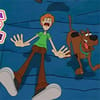
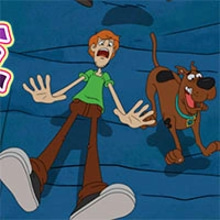
Scooby Slide starts with the kind of situation that feels very normal for Scooby-Doo, which is to say absolutely ridiculous. One second you are with Scooby and Shaggy, the next you are flying down the inside of an ancient temple while some terrifying warrior is right behind you and the floor seems personally invested in your downfall. That is the whole mood of this game. Fast, goofy, tense, and a little bit chaotic in the best cartoon way. On Kiz10, it lands as an adventure game built around motion, timing, and the very noble act of trying not to become temple-floor confetti while still grabbing enough snacks to make the escape worthwhile.
What makes the setup so fun is how instantly readable it is. You do not need a dramatic briefing. You do not need a giant map. You see Scooby. You see Shaggy. You see danger. You slide. That simplicity gives the game real energy. Scooby Slide does not spend its first minute politely warming up. It pushes you downhill and lets the panic explain the rules. A hole appears, you jump. A hazard rises, you react. A sandwich floats into view, and suddenly your brain has to decide whether survival or snacks matters more. Honestly, with Scooby involved, that is always a trick question 😅.
👣 The Chase Feels Silly Until It Suddenly Doesn’t 👣
The heart of Scooby Slide is the chase. That pressure never really leaves. The game understands something important about runner-style cartoon games: movement is fun, but movement with consequences is better. You are not just sliding for the sake of sliding. You are escaping. That changes everything. A simple jump becomes dramatic. A tiny mistake becomes a loud personal tragedy. The slope looks smooth until it throws a trap under your feet and reminds you that ancient temples have terrible customer service.
There is a lovely rhythm to the gameplay once it clicks. You begin by reacting late, probably making panicked little moves that feel much smarter in your head than they look on the screen. Then, after a few runs, you settle in. You start reading the path instead of merely surviving it. Obstacles stop feeling random. Gaps start making sense. You notice where to jump early and where to wait that tiny extra fraction of a second. And that is when the game becomes strangely addictive. Not because it suddenly gets easier, but because you begin seeing how much better you could be on the next run. Classic trap. Extremely effective.
🥪 Scooby Snacks: A Terrible Time to Be Hungry 🥪
Now let us talk about the real problem here. Not the warrior. Not the traps. Hunger. Scooby Slide wisely understands that a Scooby game without snacks would feel emotionally incomplete. So while you are hurtling through danger, the game throws sandwiches and treats into the path like the universe is trying to test whether you can make responsible decisions under pressure. Spoiler: sometimes you cannot.
This tiny detail gives the whole experience personality. Anyone can run from danger. Running from danger while also trying to hoard food? That is much more on-brand. It creates those funny little moments where your survival instinct and your greed start arguing. “Ignore the sandwich,” says your cautious brain. “Counterpoint,” says the rest of you, “sandwich.” Then you lunge toward it and narrowly survive, which feels heroic even though it was objectively a poor choice.
And that is part of the charm. Scooby Slide is not trying to be a grim temple survival simulation. It is built on cartoon logic. The fear is exaggerated, the motion is playful, and the collectible snacks give the run this extra layer of temptation that makes every stretch of track more entertaining. You are not just dodging. You are choosing your kind of chaos. Clean escape? Good. Messy escape with extra snacks? Better.
⚠️ Traps, Timing, and That One Jump You Swear Was Fine ⚠️
A game like this lives or dies on timing, and Scooby Slide gets that right. The controls are simple, but the challenge comes from reading momentum. Temple slides have a way of making everything feel slightly faster than your confidence can handle. You see an obstacle, you think you are ready, and then the ground keeps moving under you and suddenly your heroic plan becomes slapstick. Which, to be fair, is very Scooby-Doo.
The best part is that the mistakes usually feel human. You rarely fail and think, “that made no sense.” You fail and think, “I got greedy,” or “I jumped too soon,” or “why did I try to thread that gap like I was some kind of temple speedrunner?” That matters. It keeps the frustration low and the replay urge high. Every crash feels fixable. Every bad run whispers that the next one could be cleaner, longer, smarter.
And when you do hit that flow state, the game feels great. You hop over one hazard, slide into the next opening, line yourself up for a snack, recover, keep moving, and for a few seconds you feel like the coolest coward in cartoon history. Scooby and Shaggy are still terrified, obviously. But you? You are locked in 😎.
🏺 Ancient Temple, Pure Cartoon Mayhem 🏺
The setting does a lot of quiet work here. An ancient temple is already a good excuse for bad things to happen at high speed. Crumbling paths, suspicious gaps, weird obstacles, dramatic pursuit, all of it fits. Scooby Slide uses that backdrop to keep the action lively. The temple is not just scenery. It feels like a place filled with bad ideas from centuries ago, and now you get to rush through all of them with almost no preparation. Wonderful.
That environment also gives the game a strong visual identity. Even without overcomplicating the design, it feels adventurous. There is a sense of movement, old stone danger, hidden paths, and exaggerated cartoon peril. Nothing about it feels calm. Which is perfect. This is not a game for calm. This is a game for dramatic escapes, near-misses, and the kind of run where you survive by a pixel and immediately act like that was fully intentional.
Because the game is browser-based and easy to jump into, it has that lovely “one more run” quality too. You can start casually, just testing the slope, then suddenly you are chasing a higher score because you are convinced the last crash was nonsense and definitely not your fault. Then you improve. Then you get farther. Then the temple finds a new way to humble you. Healthy cycle. Very scientific.
🎬 Why This Feels So Right for Scooby 🎬
Scooby Slide works because it captures a specific part of the Scooby-Doo magic. Not the mystery-solving side, not the clue board, not Velma explaining everything in the final scene. This is the running-and-screaming part. The hallway chaos. The improvised escape. The giant exaggerated fear. The game leans into that energy and turns it into a clean, fast adventure challenge that feels playful instead of heavy.
That is why it is easy to recommend on Kiz10. If you like endless runner games, cartoon chase games, temple escape games, and fast reflex challenges with personality, there is a lot to enjoy here. It is simple enough to jump into immediately, but lively enough to keep pulling you back. You get pressure, humor, motion, and just enough snack-based nonsense to make the whole thing memorable.
Scooby Slide is basically a downhill argument between fear and appetite, and somehow both sides keep winning. You dodge, you leap, you collect, you panic, you laugh, and then you try again because surely this time you will escapes with style. Maybe even dignity. Probably not dignity, actually. But definitely style. 🐾















 4.3 (105 votes)
 Share
Share
 Embed
Embed