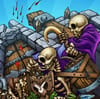
🛡️💀 THE GATE IS SHAKING AND YOU’RE THE ONLY ONE HERE
Skeleton Defense opens with the kind of situation that would normally involve a dramatic speech, a squad of heroes, and a plan. You get none of that. You get a weapon, a lane to protect, and the uncomfortable realization that the undead do not negotiate. On Kiz10.com, it plays like a fast, punchy defense game with shooter energy, the kind where your brain is doing two jobs at once: aiming in the present and planning for the next wave before it arrives like a rude surprise.
The first skeletons are almost insulting. They shuffle in like they’re testing you, like they want to see if you’re awake. You drop them, feel confident, maybe even smug. Then the game starts stacking pressure. More bones. Different types. Different pacing. Suddenly the lane looks less like “a few enemies” and more like a moving wall of problems. And that’s when Skeleton Defense really becomes itself: a game about keeping your cool while everything is trying to steal it.
🔫⚡ SHOOTING FEELS SIMPLE UNTIL IT ISN’T
At its core, Skeleton Defense is satisfying because the action is direct. You aim, you fire, enemies fall apart in the most satisfying way possible, and you instantly understand what matters: stop them before they reach you. But it doesn’t stay simple for long. Once waves begin to thicken, the questions change from “can I shoot them” to “what do I shoot first” and “how do I avoid wasting damage.”
You’ll start prioritizing without realizing it. The fast ones get your attention first because they’re annoying and they mess up your rhythm. The tougher ones become mini deadlines, because if you ignore them they soak up time and let everything else slip through. The moment you learn to stop firing like a nervous sprinkler and start firing like someone with a plan, the whole game changes. You go from reacting to controlling.
And it’s not sterile, number-crunchy control either. It’s messy control. The kind where you’re still a little panicked, but now your panic has aim. 😅💥
🧨🧊 WEAPONS THAT FEEL LIKE MOODS
A big part of the fun is that the game doesn’t lock you into one boring tool. Skeleton Defense gives you variety, and variety in a defense shooter isn’t just cosmetic. It’s survival. Some weapons are great when the lane is crowded and you need coverage. Others are perfect for deleting the tanky skeleton that’s pretending it’s invincible. Some options feel punchy and quick, others feel heavy and decisive, like every shot is a statement.
You’ll have moments where you switch weapons and immediately feel relief, like “okay, this is the right choice.” And you’ll have moments where you switch too late and you’re like, “cool, I just made that harder for myself.” It becomes a little dance: pick the right tool, at the right moment, without freezing up. Because freezing up is basically inviting the skeletons to move in and redecorate your last stand with your regrets.
🔥🛒 THE SHOP: WHERE HOPE IS SOLD IN UPGRADES
Between waves, Skeleton Defense gives you the thing every good survival defense game needs: a chance to breathe and spend your rewards. The shop isn’t just a break, it’s a strategy engine. This is where you decide what kind of defender you are.
Do you upgrade raw damage so each shot matters more? Do you improve fire rate so you can handle swarms without getting overwhelmed? Do you invest in explosive options so clustered enemies become a single loud memory? The best part is that it never feels like a boring spreadsheet decision. It feels like arming yourself for the next nightmare. You’re not shopping for fun. You’re shopping because the next wave is coming and it’s going to be uglier. 💀🛍️
And yes, you’ll make mistakes. You’ll buy something that sounded smart, then realize it doesn’t fit your playstyle. You’ll overspend on one category and suddenly feel underpowered in another. But that trial-and-error loop is where the game gets addictive. Every run teaches you something. Every upgrade path is a tiny story of survival.
⏱️🧟 WAVE PRESSURE THAT MAKES YOU SWEAT IN SILENCE
Skeleton Defense is at its best when the waves start arriving with confidence. That’s when the game’s pacing shines. It doesn’t just add more enemies; it changes the feel of the battle. The lane becomes crowded. Your aim becomes precious. You start doing those micro decisions that only happen in good action defense games: shoot the front to prevent immediate damage, or shoot the middle to thin the pack before it reaches you? Reload now, or squeeze one more shot and risk an awkward gap?
There’s a specific kind of tension when you’re holding the line by a thread. You’re not dead yet, but you can see how death could happen in about two seconds if you blink. Your hands get tighter on the controls. Your brain starts narrating. “Okay, okay, clear the fast ones. Now the big one. Now the cluster. Don’t miss. Don’t miss.” And then you miss. And you still recover. And that recovery feels incredible. 😤⚡
🦴🎭 SKELETONS SHOULD BE FUNNY, BUT THESE ONES ARE RUDE
Skeleton enemies are weirdly perfect for this genre because they’re readable and relentless. They’re also disrespectful. They keep coming. They don’t care that you’re tired. They don’t care that you just had a great wave. They show up again like a bad joke that gets funnier the more it hurts.
And the variety is what keeps it from turning into a mindless shooting gallery. Different skeleton types change your priorities. Some pressure you with speed, some with durability, some with the way they bunch up and dare you to waste ammo. The game constantly nudges you to adapt. If you try to play every wave the same way, it will politely punish you until you stop being stubborn. Or until you lose. Usually both. 😅💀
🧠🎯 THE REAL SKILL IS CLEAN DECISIONS, NOT PERFECT AIM
Sure, aim matters. But once you’ve played a bit, you’ll realize the bigger skill is decision-making under pressure. Skeleton Defense rewards players who keep shots efficient, who choose upgrades that match their weaknesses, who don’t panic-switch tools in the middle of a mess.
You’ll start learning tiny habits that make you better without feeling like “training.” Things like firing in controlled bursts instead of spraying, saving heavy damage for the right targets, and using area damage when the lane is thick. You’ll also learn the value of rhythm: if you can control the flow of the wave, you can control the difficulty. If you let the wave control you, you’re basically signing up for stress.
And the best part? When you improve, you feel it immediately. The same wave that used to overwhelm you suddenly feels manageable. You clear it cleaner. Faster. With fewer “oh no” moments. That’s the addiction right there: visible skill growth in a short, intense loop.
🏁🛡️ WHY SKELETON DEFENSE WORKS ON Kiz10
Because it’s straightforward, but not shallow. Because it delivers that classic last-stand fantasy without wasting your time. Because the upgrades and weapon choices let you play aggressively or carefully, and both styles can work if you commit. Skeleton Defense is the kind of online defense game you can jump into for a quick run, but it has that “one more attempt” pull because every loss feels like it was almosts a win.
You’ll keep thinking you can do better. You’ll keep thinking the next upgrade will change everything. You’ll keep chasing the run where the waves pile up and you still hold the line like a legend. And when you finally do? When the skeleton horde collapses under your fire and you realize you survived longer than you ever have? That moment feels loud, even if you’re sitting in silence. 💥🏆





 4.3 (22 votes)
 Share
Share
 Embed
Embed