🧱🌤️ The Calm Before the Wobble
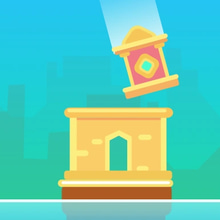
Stack Tower looks peaceful at first. A platform. A block sliding back and forth like it’s casually showing off. A sky that says, “Relax, this is easy.” Then you place your first piece a millisecond late, the edge gets shaved, and your beautiful future tower is immediately born smaller, thinner, more fragile, and slightly offended. That’s the whole trick. This isn’t just a stacking game, it’s a tiny stress machine disguised as a clean, simple puzzle. On Kiz10, it’s the kind of game you start “just to try,” and suddenly you’re staring at the screen like you’re negotiating with gravity itself. 😅
The idea is instantly readable: drop moving blocks to build a tower as high as you can. But the moment you realize the tower can shrink, the game changes. Missing the perfect alignment doesn’t just cost points, it literally changes the shape of your future. Every imperfect placement slices your next block down to match the overlap, which means you’re not only chasing height… you’re protecting your tower’s footprint like it’s a precious resource. It’s weirdly strategic for a one-tap style game. One sloppy drop and the rest of the run becomes an emergency.
🎯🧠 Timing Is the Whole Personality
Stack Tower doesn’t ask you to learn a complicated control scheme. It asks you to learn yourself. Your impatience, your rhythm, your tendency to panic when you’re doing well. The block glides. Your finger hovers. Your brain whispers “now.” Sometimes “now” is right and you feel like a genius. Sometimes “now” is a lie and your block lands half off the edge, turning your tower into a skinny toothpick. The game loves that little human moment where confidence becomes a mistake.
What makes it so addictive is how clean the feedback is. You don’t get vague consequences. You see the cut. You see the new size. You instantly understand what went wrong, and you instantly believe you can fix it on the next drop. That’s the loop. It’s a simple arcade puzzle that keeps you locked in because the failure never feels final. It feels… adjustable. “If I just wait a fraction longer.” “If I stop rushing.” “If I stop celebrating early.” And then you celebrate early again because you’re human. 🤷♂️🧱
🌈✨ The Perfect Drop Feels Illegal
There’s a special kind of joy when you land a block exactly centered. The game usually rewards this with a feeling of restoration, like you just repaired the timeline. The edges line up, the tower looks clean again, and your confidence spikes. You start thinking you’ve figured it out. You start dropping faster. Your timing gets cocky. And the next block punishes you for believing in happiness. That emotional swing is the secret sauce. Stack Tower is basically a comedy about overconfidence, and you are the main character.
And even when you’re struggling, the tower itself becomes this visual record of your choices. A wide base means discipline. A thin base means chaos. A tower that alternates sizes means you’re living dangerously but somehow surviving. You can literally see your mental state in the architecture. It’s like mood tracking, but with blocks. 😄
🏗️🌀 The Tower Becomes a Story
A good run in Stack Tower doesn’t feel like a score chase at first. It feels like a building story. The first few blocks are the foundation chapter, calm and easy. Then you hit the part where the blocks move faster or your focus slips, and suddenly you’re in the conflict arc. You start making micro-corrections in your mind. You delay your tap. You tap earlier. You try to find a rhythm. The tower grows and your tension grows with it, because every new piece is another chance to ruin everything.
And here’s the thing: the game makes you respect small wins. Sometimes the goal isn’t to land perfectly. Sometimes the goal is just to not lose more width. A decent overlap can be a victory when the tower is already skinny. You’ll find yourself accepting “good enough” in a way that feels oddly mature, then immediately refusing “good enough” the moment your tower looks stable again. It’s a cycle. You’re either a zen builder or a reckless architect, and you switch personalities mid-run without warning. 🧘♂️😈
🕹️🔥 Why It Hooks So Hard on Kiz10
On Kiz10, Stack Tower is perfect because it loads fast in your brain. There’s no long tutorial, no complex objectives, no distractions. It’s you versus timing. The sessions are short but intense, and the restart is instant, which is dangerous because it invites “one more try” like it’s an innocent suggestion. Your best runs usually happen right after a failure, because you’re focused, slightly annoyed, and determined to prove the last drop was a fluke. That determination is fuel.
It also scratches that satisfying “I’m improving” itch. You can feel your timing get cleaner. You can feel your patience increase. You can feel your eyes get better at reading motion. The game turns you into someone who can predict where the block will be a split-second later, which is a fancy way of saying it turns you into a calmer person… until you mess up again and become dramatic. 😭
🔊👀 The Tiny Tricks Your Brain Learns
After a while, you stop staring at the whole block and start focusing on the edge alignment. You begin to anticipate the swing instead of reacting to it. You stop tapping at the exact moment you see the perfect position, and you start tapping at the moment you know the perfect position is about to happen. That’s the real skill jump. It’s not faster fingers, it’s better prediction.
And you’ll discover your own rhythm. Some players do best with a steady cadence, almost like a metronome. Others do best by waiting longer and placing only when it feels undeniably right. Both styles work until pressure hits. Pressure is when you’re high up, the tower is thin, your last perfect drop gave you false confidence, and the next block is moving like it’s late for an appointment. That’s when your discipline gets tested.
🧱🚀 The Final Stretch Feels Like Walking a Tightrope
The higher your tower gets, the more every block feels like a decision with consequences. A small shave becomes catastrophic. A decent placement becomes a relief. A perfect placement becomes a celebration you try to suppress because celebrating is how you lose focus. It becomes this funny internal battle where you’re trying to stay calm while your brain is shouting, “This is the best run! Don’t ruin it!” That shout is basically a curse. The game hears it. The next block wobbles in your imagination. You tap. You pray. 😂🙏
And even when the run ends, it doesn’t feel like a hard stop. It feels like a snapshot. A measurement of how well you handled pressure for that minute. That’s why the game is so replayable. It’s not about finishing. It’s about beating your own nerve.
Stack Tower on Kiz10 is simple, sharp, and weirdly personal. It turns timing into drama, geometry into tension, and a single tap into a decision you’ll either brag about or deny ever making. If you like stacking games, balance challenges, and arcade puzzles that reward calm focus while constantly tempting you into mistakes, this one will absolutely get its hooks in. 🧱✨



 4.4 (34 votes)
 Share
Share
 Embed
Embed