🔥🐉 THE LITTLE DRAGON WITH A BIG “NOT TODAY” ATTITUDE
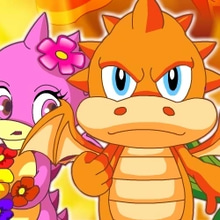
Drago Adventure drops you into a bright, classic platform world and immediately dares you to play like a clever hero, not a reckless jumper. You control a small dragon who looks cute enough to belong on a sticker… right up until you realize the levels are built to trip you, trick you, and occasionally laugh when you fall. It’s an adventure platform game with a puzzle brain hiding under its scales, and on Kiz10 it hits that nostalgic sweet spot: simple to start, surprisingly sticky once you realize the game wants you to think.
The first few moments feel friendly. You run, you hop, you learn the rhythm, you start reading the platforms. Then the game slides in its real identity: elemental power. Not as a fancy “press a button for fireworks” gimmick, but as a tool that changes how you approach obstacles, enemies, and routes. Drago Adventure isn’t satisfied with you simply reaching the end of a stage. It wants you to earn it by understanding how the level is built and how your dragon can bend it.
🌪️💧🔥 ELEMENTS ARE YOUR LANGUAGE, NOT YOUR DECORATION
The elemental mechanic is where the game quietly becomes a puzzle platformer without announcing it with a lecture. Instead of “jump harder,” you start thinking “solve smarter.” Some barriers are basically invitations to use the right element at the right moment. Some enemies aren’t meant to be brute-forced with panic jumps; they’re meant to be handled by timing and a well-chosen power. That small shift matters a lot because it makes each screen feel like a mini problem you can outplay, not just survive.
There’s a satisfying feeling when you stop reacting and start planning. You see a hazard, you spot a safe pocket, you notice a pattern, and suddenly the level isn’t chaos. It’s a map. You’ll catch yourself doing that quiet gamer analysis mid-run: if I move now I get punished, but if I wait half a second and use the element right here, I’m through. And when it works, it feels like you outsmarted the world with one clean decision. 😈
🧱🦴 THE LEVELS ARE SMALL STORIES WITH TEETH
Drago Adventure’s stages feel like compact adventures. They aren’t just long corridors. They’re sets of rooms and jumps that keep changing their mood: a section that tests timing, a section that tests patience, a section that tests whether you can stay calm while an enemy patrols exactly where you want to land. The best platform games do this thing where they keep you slightly uncomfortable, but not hopeless. This one does it well. You’re always under a little pressure, but you can usually see the answer if you slow your brain down.
It also has that classic platform vibe where you learn by failing, but the failures aren’t empty. You fail, you immediately understand what went wrong, and the next try feels cleaner. That’s why it gets addictive fast. Not because it’s loud, but because it’s readable. Every restart is a new chance to play smarter, move smoother, and keep your dragon looking like a pro instead of a confused hatchling.
⚔️🧠 ENEMIES THAT PUNISH BAD RHYTHM
The enemies in Drago Adventure aren’t complicated chess masters. They’re more like timing traps with personalities. They sit where you want to go. They move on patterns that mess with your confidence. They punish you when you get greedy with your jumps, and they reward you when you commit with purpose. That means the real battle isn’t “do I have enough damage,” it’s “do I understand the timing and spacing.” The moment you get that, fights and encounters become less scary and more satisfying, because you’re not surviving by luck anymore.
Some players try to rush through everything, and the game politely turns that into a highlight reel of mistakes. Others play with control, using the elements as intended, and suddenly the same areas feel almost easy. It’s not that the game changes. You change. And that’s one of the best feelings in platform adventures: the world stays tough, but you become better at reading it.
🌀😅 YOUR BIGGEST ENEMY IS PANIC
This is the kind of game where your hands can betray you. You see a hazard, you jump early, you land wrong, you get hit, and then you start playing faster because you’re annoyed, which makes you mess up again. Drago Adventure absolutely feeds on that spiral. The trick is to play like a patient dragon. Wait for the opening. Use the element with intention. Make your movement clean.
If a section is beating you, the answer is usually not “try harder,” it’s “try quieter.” Take one second, watch how the enemy moves, notice where the safe landing actually is, and then do a calm run. The game becomes much friendlier the moment you stop arguing with it and start listening to its timing. And yes, that sounds dramatic for a small dragon platformer, but that’s the fun. 😅🐉
🏆✨ THAT MOMENT WHEN EVERYTHING CLICKS
There’s a moment, usually after a few tries, when Drago Adventure suddenly feels smooth. You start chaining jumps. You stop hesitating. You use elemental powers naturally instead of randomly. You take a route that looked impossible and realize it’s actually simple once you do it in the right order. That click moment is the heart of the game. It turns it from “cute platformer” into “okay, I’m invested.”
And because it’s on Kiz10, the whole experience is quick to jump back into. You can do a few levels, get that sense of progress, then come back later and immediately remember the rhythm. It’s the kind of adventure game that respects your time while still giving you that satisfying “I improved” feeling.
🌋🐲 WHY DRAGO ADVENTURE FEELS DIFFERENT FROM A NORMAL PLATFORM GAME
A lot of platformers are just movement tests. Drago Adventure adds that extra layer where you’re not only moving, you’re choosing how to interact with obstacles. The elemental angle gives you small strategic choices that change the feel of a level. It’s not a massive RPG system, but it doesn’t need to be. It’s just enough to make you feel clever when you win and responsible when you lose.
If you like platform adventure games with puzzle moments, timing challenges, and a cute hero who gradually feels unstoppable as you learn the mechanics, this one fits perfectly. It’s colorful, quick, and surprisingly sharp when it wants to be. And the best part is that it doesn’t demand perfection. It just demands that you pay attention and stop treating gravity like a suggestion. 😈














 Share
Share
 Embed
Embed