🪦🎭 A Tiny Grim, A Big Problem
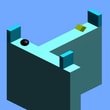
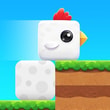
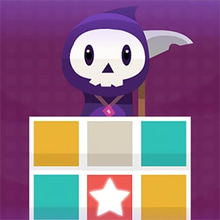
Grim Fall starts with a simple situation that immediately feels like a bad idea in the best way: the Grim is perched up high on a wobbly tower of bright blocks, looking like he’s one sneeze away from becoming a tragic cartoon. Your job is to get him down safely. Not fast, not flashy, just alive. And the second you click a block, the whole tower seems to whisper, oh, so you chose chaos today 😅.
This is a physics puzzle game that loves gravity the way a prankster loves banana peels. Every block you remove changes the balance. Every tiny shift turns into a chain reaction. Sometimes it’s elegant, like a perfect domino collapse you planned in your head. Sometimes it’s a disaster you didn’t plan at all, where the Grim slides off a ledge and you stare at the screen like… did I just do that? Yes. Yes you did.
On Kiz10, Grim Fall has that “one more try” magnetism. The levels are short enough that failure doesn’t feel like losing a life, it feels like losing a bet you immediately want to place again. You can almost feel your brain trying to solve the puzzle before your fingers do, and when you finally nail a clean landing, it’s oddly satisfying, like tidying up a mess you created on purpose 😌.
🧱🧠 Click, Remove, Regret, Repeat
The core mechanic is deliciously simple: click or tap the colorful blocks to remove them and let physics do the rest. But the trick is that physics has a personality here, and it’s not a gentle one. The Grim isn’t a magical floating hero. He has weight. He tips, he rolls, he slips, he clings to edges in that panicky way that makes you lean closer to the screen as if you can physically catch him 🫣.
At first you’ll think the answer is “remove everything quickly.” Grim Fall politely disagrees. Remove too much and the Grim drops like a rock, bouncing into failure. Remove the wrong support and he tilts, slides, and falls off the side. Remove too little and he just sits there, staring at you, as if judging your strategy. It becomes this weird conversation between you and the tower. You take a block away. The tower reacts. You adjust. The tower reacts again. It’s like negotiating with gravity while gravity laughs quietly in the corner.
And the colors matter more than you expect. They’re not just decoration. They help you read structure, spot weak points, and recognize patterns. You start thinking like an architect with zero qualifications and maximum confidence, which is a dangerous combo 😂.
⚙️🌪️ Gravity Is the Real Boss Fight
The best part is that Grim Fall doesn’t rely on complicated rules to feel challenging. The challenge comes from the way everything shifts. A block removal puzzle is basically a test of prediction: if I remove this piece, what happens next? Will the Grim roll left? Will he drop straight down? Will the platform below tilt because I accidentally removed its “spine”? The game turns you into a tiny fortune teller, except your crystal ball is just trial and error.
Some levels feel like careful surgery. You remove one block, wait, remove another, wait again. You watch the Grim settle into a safer position, then you breathe and continue. Other levels are pure demolition mood. You click a piece and the entire structure starts collapsing like it’s late for an appointment, and you’re just hoping the Grim ends up on the safe platform instead of flying into the void 😵💫.
There’s a surprising amount of timing too. Sometimes the correct move is not a different block, but a different moment. Wait for the Grim to stop wobbling. Let the tower settle. Don’t poke it while it’s mid-panic. Because if you do, you’ll create a new problem and then blame the game even though… come on, you know it was you 😬.
🎯✨ Chasing Three Stars Like It’s Personal
Grim Fall isn’t satisfied with “you finished the level.” It tempts you with better outcomes. Cleaner solutions. Higher ratings. And suddenly you’re not just trying to save the Grim, you’re trying to save the Grim with style. You might complete a level and feel proud, then notice you didn’t earn the best result and your brain goes, unacceptable, we’re running it back.
That’s where the game becomes more than a casual brain game. It becomes a puzzle optimization obsession. You start experimenting: can I remove fewer blocks? Can I keep the Grim steadier? Can I avoid that awkward bounce at the end? Can I make the collapse smoother, like a controlled landslide instead of a chaotic tumble?
The funny thing is that perfection in Grim Fall often looks messy. You’ll create these strange little ramps, accidental bridges, and precarious stacks that somehow guide the Grim down safely. It feels like building a solution by destroying it. Very poetic. Very questionable. Very fun 😄.
And because each level is bite-sized, it never feels like a long grind. It feels like a series of quick brain duels, each one daring you to be slightly smarter than your last attempt.
🕯️😈 The Grim Has No Patience, Neither Will You
The character itself adds flavor. The Grim is small, moody, and kind of hilarious in how much drama he can create just by wobbling near an edge. You’ll find yourself talking to him in your head. Stay there. Don’t roll. Please don’t roll. And then he rolls, of course he rolls, because that’s what he does 😭.
That little emotional push is what makes the game feel alive. It’s not just abstract blocks. It’s you trying to escort a fragile little reaper through a world made of unstable candy-colored nonsense. The contrast is great: grim theme, cheerful blocks, serious physics, silly failures. It’s like a spooky cartoon puzzle where gravity plays the villain and you keep inviting it back for another round.
If you like puzzle games that don’t need long instructions, Grim Fall is perfect. The learning curve is basically your own mistakes. And the game is polite about it. It doesn’t lecture. It just resets and lets you try again, which is honestly the most dangerous kind of encouragement.
🧩🔥 Why Grim Fall Works So Well on Kiz10
Because it hits that sweet spot: simple controls, clever physics, fast restarts, and enough challenge to keep your brain awake. It’s a physics-based block removal puzzle that feels satisfying whether you’re playing for two minutes or getting sucked into a full “I will beat this level properly” spiral.
It’s also the kind of casual logic game that rewards different play styles. If you’re cautious, you can solve levels with slow, careful clicks, like you’re defusing a colorful bomb. If you’re reckless, you can brute force collapses and sometimes get away with it, which feels like cheating but also feels incredible 😎. Either way, the game gives you immediate feedback. You’ll know right away if your idea is brilliant or terrible.
Grim Fall is basically a little physics playground dressed up as a puzzle challenge. You remove blocks, gravity does its thing, and your job is to be just smart enough to guide the chaos into a safe landing. And when you finally do it cleanly, the satisfaction hits hard, because you earned it.
So yeah, save the Grim. Or accidentally drop him ten times in a row and then finally save him on the eleventh attempt while whispering “I meant to do that.” Either way, you’ll want another level. And another. And another… 🪦🎨💫









 4.6 (6 votes)
 Share
Share
 Embed
Embed