🚀⚡ Wake Up, Soldier, The Screen Is Trying to Kill You
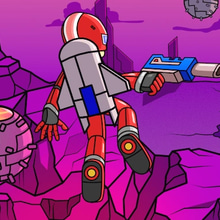
Humanoid Space Race 2 doesn’t ease you in. It drops you into that classic arcade nightmare where everything moves forward, everything shoots, and you’re the tiny, stubborn problem standing in the way. You play as a jetpack-wearing humanoid fighter in a side-scrolling sci-fi warzone, and the vibe is pure old-school intensity with a modern upgrade twist. One second you’re calmly drifting up and down like you’re just sightseeing in space, and the next you’re threading through a curtain of bullets thinking, okay, so this is how my confidence dies today.
It’s the kind of game that feels simple when you describe it and completely unhinged when you’re actually playing it. Move vertically. Shoot constantly. Survive waves. Grab power-ups before they vanish. Make choices between rounds like you’re building your own little doom machine. It’s fast, it’s sharp, and it has that “just one more run” energy that makes time do weird things. On Kiz10, it hits especially well because you can jump in instantly, get wrecked instantly, and restart instantly. No drama, just action.
🤖🔫 The Humanoid Isn’t Floating, He’s Negotiating With Gravity
Movement is deceptively basic: you’re sliding up and down across the screen, dodging, repositioning, and trying to keep your aim useful while the enemies roll in like an assembly line of bad news. But there’s a difference between moving and moving well. Early on you’ll bounce around too much, panicking, jerking upward whenever you see bullets, and you’ll end up colliding with something you didn’t even notice because your eyes were locked on one threat.
Then it clicks. You start moving like you’re surfing the chaos instead of fleeing it. Small adjustments. Tiny dips. Patient rises. You stop spamming motion and start owning lanes. Suddenly you’re not just a target, you’re a stubborn little fighter cutting a clean vertical path through a messy battlefield. And yes, you’ll still get clipped sometimes. That’s part of the charm. This game doesn’t ask if you’re ready, it asks if you’re learning.
🌌💥 Waves, Timers, and That Lovely Feeling of “I’m Fine” (You’re Not Fine)
The structure is built around waves, and waves are where the tension lives. Each wave feels like a mini survival story. Enemies march in, patterns develop, bullets build up, and you’re doing that constant scan: what’s firing, what’s drifting into my space, what’s about to trap me against the edge? Some waves feel manageable, like you can breathe and farm power-ups. Others feel like the universe decided you need character development, right now.
There’s a special kind of stress when you realize a wave ends by surviving its duration, not by eliminating everything. That changes how you think. Sometimes the best play isn’t to chase kills, it’s to stay alive and keep your damage steady while you prioritize safe positioning. It becomes this intense little balancing act: aggressive enough to clear room, cautious enough to not get cornered, greedy enough to grab boosts, disciplined enough to not die reaching for them. You’ll mess up, you’ll laugh, you’ll mutter “why did I go for that” like it was the food’s fault. 😅
🧲✨ Power-Ups That Feel Like Gifts From a Dangerous God
Power-ups are the tiny sparks of hope in the middle of the storm. They appear and your brain instantly shifts into loot mode. Your eyes lock on them, your hands start planning a path, and sometimes you do it safely and feel brilliant. Other times you dive for a power-up like a raccoon sprinting into traffic and you explode immediately. That’s the honest truth of it.
But when you collect them consistently, the game transforms. Your weapon feels stronger. Your survival window widens. You start pushing through waves that used to crush you, and you get that delicious arcadey power fantasy where you’re not just surviving, you’re imposing your will. For a moment the bullets look less like a wall and more like a puzzle you can solve.
🛠️🧠 Between Waves: The Upgrade Room Where You Become a Different Kind of Monster
After a wave ends, the game gives you choices. Not a big complicated skill tree that makes you feel like you’re filing paperwork, but quick decisions that matter. You’ll pick upgrades that shape how you play. More damage so enemies melt faster. More survivability so mistakes don’t instantly erase you. More efficiency so your run scales instead of plateauing. And because you choose in the heat of momentum, the upgrades feel personal. You’re basically telling the game, this is how I want to fight.
There’s also that sneaky psychological trap: you’ll pick an upgrade you think is perfect, then the next wave will punish that exact decision and you’ll stare at the screen like it betrayed you. But it didn’t. You just learned something. Maybe you needed mobility more than raw damage. Maybe your build is strong but your positioning is sloppy. Maybe you’re playing too aggressively and the game is begging you to chill for half a second. The upgrade system doesn’t just make you stronger, it teaches you to reflect without slowing the pace. That’s rare, and it works.
🎮😈 The Real Enemy Is Your Hands Getting Too Confident
Humanoid Space Race 2 is one of those games where you improve in layers. First you learn the basics: don’t slam into enemies, don’t sit in obvious firing lines, don’t float in one spot like a gift. Then you learn pattern awareness: how waves build, where danger clusters, when to retreat. Then you learn discipline: you don’t chase everything, you don’t grab every power-up if it’s a trap, you don’t drift into corners because you “think it’s safe.” The game loves punishing lazy comfort.
And yet it never feels unfair in that annoying way. It feels honest. When you die, you usually know why. You got greedy. You tunnel-visioned one target. You overcorrected your movement and clipped a bullet you could’ve dodged with a smaller adjustment. It’s harsh, sure, but it’s the good kind of harsh. The kind that makes you restart with a plan instead of quitting in frustration.
🔥🚀 That One Perfect Run Where Everything Aligns
At some point you’ll hit a run where the upgrades line up, the power-ups appear at the right moments, and your movement suddenly feels smooth, like you’re dancing through the chaos. That’s the addictive peak. You’re sliding up and down with intent, shooting without panic, dodging like you can see the future by half a second. Enemies pop, bullets miss, and you feel unstoppable.
Then the game will throws a new wave at you that looks familiar but behaves just differently enough to ruin your rhythm. And you’ll have that tiny moment of “wait, what” before you recover. Or you won’t recover, and you’ll explode, and you’ll laugh because the game basically just reminded you who’s in charge. 😭
That cycle is the heart of Humanoid Space Race 2 on Kiz10. It’s arcade action with bite. It’s a bullet hell shooter that rewards calm control more than frantic speed. It’s a game where upgrades matter, but skill matters more. And it has that classic sci-fi vibe where you’re one lone fighter holding back waves of mechanical nonsense, not because anyone asked you to, but because you refuse to let the screen win.





 Share
Share
 Embed
Embed