☕🔒 THE CAFE IS CLOSED, AND IT’S PERSONAL
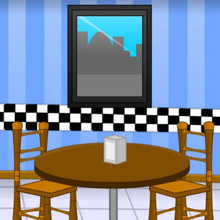
Locked Cafe Escape has that oddly believable nightmare vibe: you step away for a second, you come back, and the café feels… wrong. Not haunted, not loud, just empty in a way that makes your thoughts sound too clear. Chairs sit where they should, the counter looks normal, the lights don’t flicker dramatically, yet the door is locked and your friend is gone. That’s the hook. It’s not a monster chasing you. It’s the uncomfortable fact that something simple, like a café, can become a puzzle box the moment the exit stops cooperating.
This is classic point and click escape logic: the room is your opponent, but it pretends to be furniture. Your job is to stop trusting appearances. Every sugar jar becomes a potential container. Every menu board becomes a potential cipher. Every “boring” corner becomes the exact place the designer hid the one clue you’ll swear wasn’t there five seconds ago. And the best part is how quickly your brain flips into escape mode. You go from calm to full detective in a heartbeat. Okay. I need a key. Or a code. Or something sharp. Or something that looks useless now but becomes vital later, because that’s how these games love to flirt with your sanity.
🧠🧾 SMALL DETAILS, BIG CONSEQUENCES
Café escapes are sneaky because the environment is packed with objects that feel decorative. Cups, napkins, coffee machines, signs, drawers, shelves, condiment racks… it’s basically a playground for hidden-object mischief. You’ll find yourself clicking on everything that could open, slide, flip, or reveal a compartment. It’s not random clicking when it’s done right, it’s a method. Sweep the room. Check left to right. Re-check after you solve something because new hotspots often appear once the game decides you’ve “earned” them.
And you will overthink. It’s unavoidable. You’ll see three posters and immediately assume they represent a three-digit code. You’ll stare at a row of mugs and decide the colors must mean something. Sometimes you’ll be right and feel like a genius. Sometimes you’ll be completely wrong and still feel entertained, because the process is the fun. Escape games are basically your brain arguing with a room until one of you gives up. Spoiler: it’s usually the lock that loses, eventually. 😅🔓
🗝️🪑 THE INVENTORY IS YOUR SECRET WEAPON
The most satisfying part of a point and click escape game is the moment you realize an item isn’t just an item. It’s leverage. A small tool becomes access. A scrap of paper becomes a pattern. A strange symbol becomes a combination. In a café setting, the items tend to feel grounded, which makes the puzzles feel fair. You’re not assembling a spaceship from moon rocks. You’re doing clever little human solutions: open a drawer, find a clue, match it to a sign, use it to unlock something else, repeat until the exit finally respects you.
The inventory also creates that slow-burn momentum. At first, you have nothing and everything looks suspicious. Then you find one object and suddenly the room feels less intimidating. Then you find another and your confidence starts rising. Then you hit a puzzle that doesn’t budge and your confidence evaporates like steam off a fresh espresso. It’s a cycle, and it’s weirdly addictive. ☕🫧
🧩🧷 CODES THAT FEEL LIKE WHISPERS
Café-themed escape puzzles love numbers and symbols because cafés are full of structured information: menus, price boards, labels, signs, table numbers, receipts. That means the room can hide a code without feeling forced. You might find a clue that suggests an order of items, or a pattern that points to a sequence, or a visual hint that makes you read objects differently. The best puzzles in this setting are the ones that make you go, ohhh… that was in front of me the whole time, wasn’t it?
You’ll likely bounce between a few puzzle types: matching shapes, reading a clue in the correct order, unlocking a small container that leads to a bigger lock, and doing that classic escape maneuver where you combine information from two different places in the room. It’s less about pure math and more about observation plus patience. If you’re stuck, it’s usually because you missed one tiny detail or interpreted the clue in the wrong direction. The room almost never wants you to brute force. It wants you to notice. 😌👀
😈☕ THE FUNNY PART: A CAFE MAKES YOU FEEL SAFE, SO YOU GET SLOPPY
This game style is great because the setting lowers your guard. You’ll assume something is decoration because cafés are filled with clutter. And that’s exactly why the puzzles work. A napkin stack can hide a clue. A chalkboard can hide a pattern. A cookie jar can hide something important, because of course it can. The setting is friendly, so you relax, and then you realize you’re trapped and suddenly the cute vibe turns into focused chaos. Not screaming chaos. More like quiet, determined chaos where you’re muttering, “I am not losing to a drawer.” 😤🗄️
And when the solution clicks, it feels clean. Escape games don’t usually reward you with explosions. They reward you with certainty. A lock opens. A compartment slides. A final door gives way. You get that little rush of “I solved it,” the kind that makes you want to immediately start another room just to chase the feeling again.
🏁🔓 WHY THIS KIND OF ESCAPE GAME HITS ON Kiz10
Point and click escape games are perfect browser games because they’re instant, satisfying, and easy to replay. You can sit down for a few minutes, solve a few steps, and feel smart. Or you can get pulled into the stubborn loop where you refuse to stop until you escape, because leaving mid-puzzle feels like abandoning your own brain in the café.
If you enjoy room escape games, hidden object hunting, small logic puzzles, and that cozy-but-trapped atmosphere where everyday objects turn into clues, Locked Cafe Escape is exactly the flavor: grounded, puzzly, and quietly intense. Just remember the golden rule of every escapes room ever: if it looks harmless, click it anyway. ☕🗝️





 Share
Share
 Embed
Embed


