⚡🌈 The First Second Feels Easy, Then the Lights Start Laughing
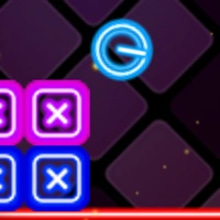
Neon Dash 2 begins like a promise: clean neon, simple shapes, a runner that looks ready, and a track that seems almost friendly. That’s the trick. You take your first steps and your brain goes, “Okay, I get it.” Then the next obstacle drops in, the timing window shrinks, and suddenly you’re not playing a relaxing arcade run… you’re negotiating with gravity at full speed while the entire screen glows like it’s cheering for your mistakes. On Kiz10, it’s that kind of skill runner where you don’t need a long explanation to feel the hook. You move, you react, you jump, you switch lanes, and you realize the only real button is courage. 😅⚡
The core idea is delightfully mean: the run keeps going, hazards keep arriving, and you survive by jumping back and forth across a neon path while chasing stars like they’re little floating trophies with attitude. The moment you grab one, you want the next one. The moment you miss one, you feel it in your chest like you dropped a snack on the floor and your soul watched it happen in slow motion. It’s an endless runner, but it doesn’t feel endless in a boring way. It feels endless in a “how long can your focus stay sharp before you blink wrong” way. ⭐😵
🌀🧱 Two Lanes, Infinite Regrets
The “back and forth” movement is the heartbeat of the game. You’re not wandering across a huge map with a thousand choices. You’re working with a tight space and fast decisions. That’s what makes Neon Dash 2 so addictive: small control, huge consequence. One lane looks safe until a spike shows up. The other lane looks safe until you switch and realize you switched into disaster. And the funniest part is how confident you can feel one moment, then how fragile that confidence becomes the second you commit to a jump you didn’t fully read. 😭
There’s a rhythm to the lane switching that starts to feel physical, like your hands are learning a dance rather than pressing keys. Left, right, jump, recover, left again. At first it’s frantic. Later it becomes smoother, almost stylish, like you’re sliding through neon trouble with a little swagger. Then the game bumps the speed or stacks hazards in a nastier pattern and you’re back to pure survival mode, muttering “okay okay okay” like that counts as strategy. 🙃💨
⭐🧲 Star Greed Is a Real Condition Here
Stars are the shiny bait that turns a safe run into a risky one. You see a star floating near a hazard and your brain immediately rewrites your priorities. Survival? Important, sure. But also… star. The game knows exactly how to place them so that you’re always tempted to do something slightly reckless. The star isn’t just a collectible; it’s a dare with a glow effect. And when you pull it off, when you grab the star and land clean, you get that micro-burst of pride that makes you sit up straighter like you’re suddenly a professional. 😎⭐
But Neon Dash 2 is also good at making you pay for greed. That’s not a complaint. That’s the fun. A great arcade runner isn’t about being fair all the time; it’s about being honest. If you rush a jump because you wanted the star, you’ll get clipped. If you switch lanes late because you hesitated, you’ll get clipped. If you jump early because you panicked, you’ll get clipped. The game is basically a neon mirror: it reflects your habits back at you with consequences. And because retries are quick, you don’t feel punished, you feel challenged. “Again.” Always again. 🔁✨
🎧🔥 Flow Mode Feels Like Flying, Until It Doesn’t
There’s a moment that happens after a few attempts where you enter flow. Your eyes stop staring at your character and start reading the track ahead. Your reactions become shorter. You stop thinking in full sentences and start thinking in tiny impulses: “switch,” “jump,” “hold steady,” “don’t overdo it.” That’s when Neon Dash 2 feels incredible. The neon lights aren’t just decoration anymore, they’re part of the mood, like the whole game is a glowing tunnel and you’re a spark trying to keep up. ⚡🛸
And then, inevitably, you break flow. Not because the game “got unfair,” but because you got comfortable. Comfort is dangerous in this genre. Comfort makes you stop scanning ahead. Comfort makes you assume the next obstacle will be like the last obstacle. Comfort makes you switch lanes on autopilot… and autopilot is how you jump straight into something sharp. The crash isn’t just a fail state, it’s a little reminder: stay awake. The neon world rewards attention, not arrogance. 😅🧠
🚧😈 Obstacles Don’t Block You, They Interrupt Your Confidence
The obstacles in Neon Dash 2 aren’t complicated, but they’re timed to mess with your timing. That’s a big difference. A spike isn’t scary on its own. A spike that appears right after you switch lanes, right when you’re mentally patting yourself on the back, is terrifying. The game thrives on those tiny mental traps. It wants you to celebrate too early, to chase a star too hard, to jump because you’re nervous, not because you should. It’s not just testing reflexes, it’s testing discipline. 🥴
The best runs come from “small” play. Small lane changes. Small calm jumps. Small corrections. Big movements are for panic, and panic is expensive. If you start wobbling back and forth like you’re trying to confuse the game, you usually confuse yourself instead. Neon Dash 2 is cleaner than that. It likes players who commit early, move smoothly, and keep an escape option in mind. And yes, that sounds dramatic for a neon runner, but that’s why it’s fun: it’s simple, but it asks you to be sharp. 🎯💥
🧊🧠 Tiny Habits That Make You Last Longer
If you want to push your high score without turning the game into a stressful science project, build a few instincts. First, always look one obstacle ahead, not at your feet. Your character will do what you tell them; your eyes need to tell you what’s coming. Second, don’t spam switches. Switching is powerful, but it’s also a commitment. Switch with purpose, not with fear. Third, treat stars like optional bonuses, not mandatory food. If a star is placed in a risky spot and you’re already unstable, let it go. Missing one star hurts for a second; losing the run hurts longer. 😌⭐
Also, when you fail, don’t rush the restart with anger. Take one breath and remember what actually happened. Was it a late jump? A greedy switch? A star tunnel vision moment? The game is very honest about your mistakes, and that honesty is a gift. Fix one thing. Just one. Suddenly your runs get longer without you even noticing, and you’ll hit that satisfying moment where you realize you’re not “trying to survive” anymore… you’re controlling the run. 🏁✨
🏁💫 The Real Reward Is That “I’m Dialed In” Feeling
Neon Dash 2 is the kind of arcade runner you play for that crisp, focused state where everything feels fast but manageable. It’s bright, it’s intense, it’s simple in the best way, and it turns your tiny decisions into big moments. On Kiz10, it’s perfect for quick sessions that accidentally turn into longer ones, because every failure feels close, every success feels earned, and every new personal best feels like you just stole a win from the neon universe itself. Now hit play, switch clean, jump sharp, and try not to stare at the stars like they’re hypnotizing you. They are. ⭐😵💫





 2 (18 votes)
 Share
Share
 Embed
Embed


