The city looks almost peaceful from up here. Rooftops stretch out in every direction, streets hum far below, and the only sound that really matters is the soft breath inside your own scope. In Professional Sniper 3 you are not a wild action hero spraying bullets in every direction. You are the quiet name on a file, the person people call when a delicate problem needs one precise solution. One mission, one shot, one very small margin for error. 🎯
You start each level before a single bullet leaves the chamber. A dossier opens, text slides across the screen, and suddenly you have a story in your hands instead of just a target. Maybe you are told about a corrupt figure in a crowded plaza. Maybe a hostage situation has spiraled out of control. Maybe someone in a group of identical stick figures is hiding a terrible secret. The brief gives you hints a color of clothing, a suspicious action, a location they will move toward. Every detail matters, because pulling the trigger on the wrong person ends the mission faster than any enemy ever could.
That briefing phase becomes its own kind of tension. You are not under fire yet, but you can feel the weight of what is coming. You read slowly, then read again, mentally underlining phrases you know you will need later. When the game finally pushes you to the vantage point and you see the scene from behind the rifle, the challenge is no longer just about aim. It is about memory. Can you match what you see through the scope to what you read thirty seconds ago.
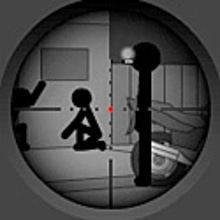
Once the mission begins, the world shrinks down to the circle of glass and the stick figures moving inside it. Professional Sniper 3 keeps its visuals clean and simple, using that classic stick style to strip away distractions and focus your attention on behavior and positioning. Without detailed faces to stare at, you look at posture, at patterns, at which figure keeps glancing over a shoulder in a way the others do not. That is a clever trick. The absence of detail forces your brain to do the work. 👀
The first time you line up a shot your hands might fidget a little. The crosshair floats over a crowd, your objective echoing in the back of your mind, and you try to steady both the scope and your nerves. A smooth breath in, a slower breath out, and a tiny correction to the side. You squeeze the mouse or key rather than slap it. The recoil snaps the scene for a heartbeat and then the result unfolds. Either your target drops and the mission lognods in approval, or you watch the wrong figure fall and feel that cold wash of instant regret.
Failure here is not noisy. There are no massive explosions or dramatic cutscenes screaming at you. Instead there is a quiet rewind and a silent lesson. You misread the brief. You rushed the shot. You ignored one small line of text at the start. On the next attempt you are a little more patient. You study the crowd longer, wait for that one tell that proves who is who, and only then do you let the bullet leave the barrel. When you finally see the right target fall and the mission clear, the relief is deeper because you know exactly what you did differently.
Over time you begin to treat each mission as a puzzle before it becomes a shooting gallery. Some stages ask for speed, pushing you to act before a suspect escapes in a car or reaches a safe zone. Others reward patience, hiding the correct target among innocents and daring you to take the time to notice a tiny detail in their behavior. You may watch someone drop an item, or see who reacts to a distant sound. That variety keeps you on edge and prevents you from falling into a lazy pattern of simply shooting the most obvious figure.
The environments change just enough to keep your senses awake. You might be perched above a city street, then suddenly find yourself watching a warehouse yard, then guarding a more open area where cover is thin and angles are wide. Each layout has its own story. Some give you narrow corridors of fire, forcing you to wait until the right character walks into your limited view. Others offer broad lines where you can see almost everything, which sounds easier until you realise how overwhelming it is to track multiple potential threats at once.
The controls stay minimal and clean. Aim, zoom, fire. There is a confidence that comes with that simplicity. You never fight the interface, so any mistake feels like a genuine moment rather than a mechanical glitch. Because the game uses stick figures, you do not need an expensive machine or complex inputs to feel involved. All the pressure flows through a few small movements of the mouse or finger and that single click that ends each scene.
Mission design leans into clever twists. Sometimes your target is alone but guarded by a strict time limit. Sometimes they blend into a line of nearly identical figures and you must use the environment to tell them apart maybe one stands slightly outside a group, maybe one walks faster, maybe one interacts with an object the others ignore. There are stages where collateral damage ends the mission, and others where you must neutralize multiple threats before they hurt anyone else. That shifting rule set keeps you alert, because assuming every level works the same is an easy way to fail.
Professional Sniper 3 also plays with perspective in subtle ways. When you zoom in, the world becomes cramped and intense. You see small gestures but lose track of the larger pattern. When you zoom out, you regain awareness of movement and positioning but lose the fine detail that proves who the real threat is. Good players learn to drift between those views, using wide shots to understand the scene, then snapping into close focus for the moment of truth. It feels a bit like breathing blinking between big picture and single heartbeat.
There is a quiet satisfaction in how the game respects your learning curve. Early missions are forgiving enough to let you misread a clue and still recover. Later missions are not. They expect you to treat each brief like a contract you actually signed. You begin marking details in your head before the level even loads check the hat, note the color, count how many guards, remember which side of the street they will come from. The sniper fantasy deepens when you catch yourself mentally rehearsing missions before you even click start.
Because each stage is self contained, Professional Sniper 3 works perfectly for short sessions on Kiz10. You can log in, complete a mission or two, feel that spike of tension as you line up a difficult shot, then close the game with the sense that you accomplished something. Or you can stay longer, chasing perfect runs and trying to clear missions without a single wasted bullet. The design supports both the quick player looking for a brief challenge and the focused player hungry for clean execution.
What really defines the experience is the mood. This is a stick sniper game, but it carries a more serious tone than its simple lines might suggest. There is humor in how dramatic your own mistakes can feel, yet the actual missions demand respect. You are encouraged to think, to observe, to read. Random shooting never brings progress for long. The more carefully you approach each contract, the more the game opens up as a satisfying chain of solved problems rather than a chaotic shooting spree.
On Kiz10, Professional Sniper 3 stands out among action and shooting titles as a more methodical challenge. It gives you the fantasy of being a professional shot without drowning you in complex menus. Everything you need fits inside the brief, the scope and your own ability to stay calm. If you enjoy games where a single decision matters more than a hundred reflex actions, this is exactly the kind of sniper experience that will keep calling you back for one more contract.





 Share
Share
 Embed
Embed


