🏙️💰 Rooftops, sirens, and two idiots with a bag of coins
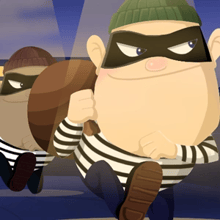
Robbers in Town starts like every “great plan” starts: with confidence that lasts exactly three seconds. Two thieves are on the move, the city is asleep (kind of), and the rooftops ahead look like a clean getaway route… until you notice the gaps, the spikes, the sudden bombs, and the fact that you’re controlling two characters who can absolutely ruin each other’s lives with one mistimed jump. It’s a two-player running game with a simple idea that turns into pure coordination drama: keep both robbers alive, keep them moving, collect as much money as you can, and don’t let the city’s traps turn your escape into a slapstick headline.
This isn’t a slow platform adventure where you stand still and think for five minutes. The game has momentum. It wants you to move forward, react quickly, and make decisions with your fingers instead of your brain’s long-term planning department. The rooftops scroll by like a chase scene, and the whole challenge becomes a tiny relationship test: can you and a friend stay synced when danger pops up every second? Or, if you’re playing solo, can you keep your own timing consistent while you manage both sides like a stressed-out conductor trying to keep an orchestra from falling apart? Either way, it’s the kind of arcade escape game that feels immediately readable, but it keeps biting until you respect it.
🕹️😵 Two jump buttons, infinite ways to fail
The beauty of Robbers in Town is how little it needs to explain. Each robber has a jump control, and your job is to time those jumps as obstacles appear. That’s it. No complicated combat, no inventory, no giant tutorial. Just timing, spacing, and the constant temptation to jump too early because you panic. The moment you understand the controls, you also understand the fear: the rooftops don’t wait for you.
The game becomes a rhythm challenge dressed as a platform runner. You see the next hazard, you count the beat in your head, you hit the right jump at the right time, and you feel that tiny burst of satisfaction when both characters clear the danger cleanly. Then the game changes the spacing by a hair, adds a second trap right after the first, and suddenly your rhythm collapses like a cheap folding chair. 😅 That’s where the real fun begins, because you’re not just reacting anymore. You’re learning patterns, predicting distances, and building that “okay, now” instinct that makes you feel skilled instead of lucky.
💣🧱 The city is basically one long prank
The rooftops are full of obstacles that feel designed to lure you into mistakes. A simple gap becomes a double gap. A safe stretch becomes a trap chain. Sometimes the hazard is obvious and your only job is to jump. Other times the danger is in the timing: jump too early and you land badly, jump too late and you clip the edge, jump at the wrong moment and you trigger the worst possible outcome. You’ll also notice how the game likes to place danger right after reward, because nothing makes a player greedy like a shiny line of coins.
And greed is the enemy. Greed makes you jump in a hurry. Greed makes you chase one last coin even when the next platform looks suspicious. Greed makes you forget you’re controlling two robbers, not one, and the second robber politely reminds you by exploding on a trap you completely ignored. It’s cruel, but it’s funny, because the game is honest about what happened. You didn’t lose to randomness. You lost because you got confident.
🪙✨ Loot runs that turn into tiny obsessions
The money you collect isn’t just decoration. It’s the emotional fuel of the run. Seeing coins scattered across rooftops turns the escape into a score chase, and score chases do something dangerous to your brain: they make you replay. You’ll finish a run and immediately think, “I could do that cleaner.” You’ll fail a run and think, “I was one jump away from a huge coin streak.” And suddenly you’re back in, trying again, because the game has that perfect arcade loop where attempts are quick, lessons are instant, and progress feels personal.
There’s also something satisfying about the shared goal when playing with a friend. You’re both invested in the same run, both reacting to the same hazards, both feeling that little surge when you clear a tricky sequence together. It becomes teamwork without speeches. Just timing, trust, and the occasional yelling like, “JUMP!” even though the other player already jumped and now you feel silly. 😄
🤝😬 Co-op energy: friendship, betrayal, and accidental sabotage
Robbers in Town is secretly a social game. When you play two-player, you’re not just trying to win, you’re trying not to mess up in a way that ruins the other person’s run. That pressure creates moments that feel ridiculous and memorable. One player is calm, the other is panicking. One player jumps too early, the other waits too long. Then you get that rare clean stretch where both of you are perfectly synced, and it feels like you’re unstoppable… until the next trap reminds you that nobody is unstoppable on a roof full of explosives.
If you play solo, it becomes a different kind of challenge: a focus game. You’re watching both robbers, timing both jumps, and trying to keep your attention split without getting overwhelmed. It’s surprisingly intense in a quiet way. Your eyes flick left, then right, then forward, and you’re constantly predicting what’s coming next. It feels like juggling, except the balls are robbers and the floor is lava. 🔥
🧠⚡ The trick to surviving longer (without turning into a panic machine)
The best way to improve is to stop treating every obstacle like an emergency. The game punishes panic-jumping because panic-jumping is rarely precise. Instead, let the obstacles come to you. Watch the spacing. Learn the “feel” of how far a jump carries your robber. When you’re unsure, aim for safety first and greed second. Coins are nice, but a dead robber has zero coins, so the math is brutally simple.
Another helpful habit is to think in pairs. Don’t think, “I need to jump.” Think, “Robber A jumps now, Robber B jumps now.” Keeping that mental structure makes your timing cleaner, especially when traps arrive in quick sequences. And when you fail, don’t change everything. Change one thing: jump a fraction later, or earlier, or resist going for the coin line that keeps baiting you. That’s how you build consistency.
Robbers in Town on Kiz10 is a compact, chaotic escape runner where the thrill comes from coordination and timing, not complicated mechanics. It’s fast, funny, and just punishing enough to make every clean sequence feel like a victory you earned. You’ll dodge traps, grab loot, argue with your own reflexes, and keep replaying because the perfect run always feels one jump away. 🏙️💰














 4 (30 votes)
 Share
Share
 Embed
Embed