⚖️🐾 A scale, a problem, and the kind of balance that hates you back
Touch Balance on Kiz10 looks like the simplest deal in the world: there’s a scale, there are objects (often cute animals or chunky weights), and your job is to make both sides balance. Easy, right? Until you realize “balance” isn’t only about matching numbers. It’s about placement. Leverage. Space. That cruel little truth that a small object near the edge can cause more chaos than a bigger object near the center. And once the level starts, the scale doesn’t wait for you to feel confident. It reacts instantly, tipping like a judgmental seesaw that has seen too many bad decisions.
This is a physics puzzle, but not the slow “sip tea and think for ten minutes” kind. The pace is snappier. The game wants you to act, test, adjust, and commit. You’re constantly dealing with the tension between thinking and doing. Place something too quickly and you’ll watch the platform tilt, slide, and dump everything into the void. Think too long and you’ll feel the pressure rising because the level is clearly expecting you to move. Touch Balance is basically a puzzle that turns your hands into the brain’s accomplice. You’re not only solving, you’re handling the solution.
🧠🎯 The real trick is leverage, not math
If you’ve ever tried to balance anything in real life, you know the secret isn’t “equal stuff.” It’s equal force around a pivot. Touch Balance leans into that idea in a way that feels playful and mean at the same time. Put weight far from the center and the scale behaves dramatically. Put weight close to the middle and it behaves calmer. So now you’re not just choosing what to place, you’re choosing where it goes and how risky that choice is.
This creates those satisfying moments where you feel like you’ve outsmarted the level. You might use a heavier piece but tuck it near the center to keep the system stable, then counter it with lighter pieces placed wider on the other side. The scale starts leveling out, the wobble slows, and you get that quiet “yes… yes… stay there” feeling while your eyes watch the needle like it’s a life-support monitor 😅
And when you fail, it rarely feels mysterious. You’ll usually know exactly what happened. You went too wide. You stacked too high. You put something on a slope that was already begging to slide. Physics didn’t betray you. Physics just showed you the bill.
⏱️💥 Time pressure that turns calm puzzles into tiny emergencies
A lot of balance games add a timer or a limited move feeling, and Touch Balance thrives when you’re forced to decide under pressure. Because the easiest way to lose is hesitation paired with panic. If you freeze, you start doubting every option. Then you rush. Then you place something badly. Then the whole structure shifts and you’re suddenly in damage-control mode, trying to “save” a tilt that’s already committed to disaster.
The game teaches you a weird skill: calm speed. Not frantic speed. Calm speed. That means you develop a routine. Quick glance at the scale. Quick guess at what side needs help. Place near the center first to stabilize. Then widen out carefully when you’re confident. It’s the same idea as building a tower: you don’t start with the risky part. You earn the risky part.
🐒🐯 Cute pieces, serious consequences
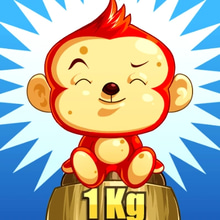
If Touch Balance uses animals as weight pieces, it adds a funny layer because your brain wants to treat them like decorations. But the game treats them like physics objects with very real mass. A tiger, a monkey, a crate, a rock… it doesn’t matter what it is, the scale only cares about weight and distance. That contrast is where the comedy lives. You’ll place something adorable and immediately watch it ruin the entire balance like it was secretly sabotaging you.
And the level design often sets up puzzles that look like simple equivalences but aren’t. You might see a big piece and assume it must be countered by another big piece. Then you realize you can counter it with multiple smaller pieces if you place them smartly, or you can counter it with one medium piece placed farther out. Suddenly you’re not doing “who is heavier,” you’re doing “who creates more torque.” That’s the kind of puzzle thinking that feels satisfying because it’s real-world logic disguised as a quick browser game.
🧩🧱 Stacking, sliding, and the nightmare of unstable geometry
The nastiest levels in Touch Balance usually aren’t the ones with the biggest weights. They’re the ones with awkward shapes and slippery placements. A flat base is forgiving. A rounded object is not. A tall stack looks impressive until you realize it’s a wobble factory. One small shift and everything starts drifting, and drifting turns into falling, and falling turns into you staring at the screen like it personally disrespected you.
So you learn to build “boring” solutions. Low and wide. Balanced in shape as well as weight. If you pile everything on one corner, you’ll get punished. If you distribute weight thoughtfully, the scale behaves. It’s almost like the game is training you to think like an engineer while pretending it’s just a silly balance toy.
There’s also the satisfying moment when you use the environment itself. Sometimes the platform edge can be used to “catch” a piece and stop it from sliding. Sometimes placing an object slightly inward prevents it from rolling. These tiny adjustments feel small, but they’re the difference between a stable solve and a collapse that happens two seconds after you thought you won.
😵💫🎭 The emotional loop: “It’s balanced!” … “Why is it still moving?”
Touch Balance loves the slow wobble. The moment where you think you nailed it, the scale looks level, and then it keeps oscillating like it’s laughing quietly. This is where patience matters. A solution isn’t truly safe until it settles. If you keep adding pieces while the scale is still swinging, you amplify the swing and create chaos. The smarter play is to place, wait a beat, let it calm, then place again.
This is also where the game becomes a tiny mind game with yourself. Your instincts want to finish quickly. The puzzle rewards restraint. You’ll catch yourself saying “one more piece and it’s perfect,” and sometimes that’s true… and sometimes that “one more piece” is exactly what tips the entire structure past the point of recovery. That mistake is so common it becomes part of the charm. Touch Balance is basically a lesson in not getting greedy.
🧠✨ How to win more consistently without turning it into homework
Start with the center. Use the middle of the scale as your safe zone. If you can stabilize the heavier side near the center first, you buy yourself time and control. Then adjust outward with smaller pieces to fine-tune the balance.
Watch the far edges. Edges are powerful, but dangerous. Anything placed far out has more impact, which means it can fix a problem quickly… or create a bigger one instantly. If you’re close to perfect balance, do not “edge gamble.” Place closer in and make tiny corrections instead.
Keep stacks low when possible. If the game allows stacking, remember that height creates instability. A flat, wide arrangement settles faster and resists sliding.
And most importantly: stop trying to “match visually.” Balance puzzles trick your eyes. Your eyes want symmetry. Physics wants torque equality. Sometimes the correct solution looks uneven. That’s okay. The scale doesn’t care if it’s pretty. It cares if it’s stable.
🏁⚖️ Why Touch Balance on Kiz10 is so replayable
Because it’s short-session friendly, instantly understandable, and still capable of humiliating you with one tiny mistake. You can solve a level in seconds and feel smart. You can fail a level in one second and feel offended. The feedback is immediate, the physics are readable, and the improvement feels real. You start learning how to place objects, how to calm the wobble, how to use distance like a tool, and how to stop sabotaging yourself with rushed decisions.
Touch Balance is that perfect kind of physics puzzle: easy to start, hard to perfect, and always one cleaner placements away from feeling like a genius. And when you finally land the last piece, the scale settles, and everything holds… it’s a tiny moment of peace you absolutely earned. ⚖️🐾



 3.9 (19 votes)
 Share
Share
 Embed
Embed


