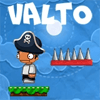
🌤️ A tiny hero, a tall sky, and absolutely no chill
Valto Jump is the kind of platform game that looks innocent for a moment and then starts testing your nerves almost immediately. You guide a young adventurer upward through a dangerous vertical path, hopping from ladder to ladder, avoiding spikes, and collecting stars while the climb grows more intense the higher you go. Public descriptions of the game consistently frame it as a high-skill jumping challenge built around vertical ascent, traps, and star collecting, which fits the experience perfectly.
What makes it click so fast is the simplicity of the idea. There is no giant tutorial speech, no complicated control scheme trying to impress you, no fake depth hiding behind menus. You jump. You climb. You survive. That purity gives the game a sharp arcade feeling, and on Kiz10 that kind of direct platform challenge always has a certain magic. You are in the action almost instantly, and within seconds your brain is already doing that familiar little calculation: distance, timing, landing, don’t mess this up, oh no, I messed this up.
And yet, that is exactly why it works. Valto Jump knows that a good jumping game does not need to be noisy. It needs rhythm. It needs tension. It needs that delicious sense that one tiny mistake can ruin a beautiful run.
⭐ Stars, ladders, and the art of not panicking
The real heart of Valto Jump is control under pressure. Every upward move asks for judgment. Go too early and you clip danger. Wait too long and you lose your rhythm. Drift carelessly and the stage punishes you with the kind of blunt honesty only arcade platformers can deliver. The stars scattered through the climb add a tempting extra layer, because they are never just decorations. They pull your attention, challenge your route, and dare you to be greedier than you should be.
That is where the game becomes more than a basic jumper. It starts whispering bad ideas into your ear. You could take the safe route… or you could stretch for that star hanging just far enough away to become suspicious. Naturally, players choose glory, disaster, or some combination of both. This creates a really fun rhythm where each section feels like a tiny negotiation between survival and style.
It also makes the game strangely personal. In action games, failure can feel chaotic. In Valto Jump, failure feels precise. You know exactly which jump went wrong. You know the moment your confidence got ahead of your hands. That clarity makes retries feel fair, and fair retries are dangerously addictive. One more attempt becomes five. Five becomes fifteen. Suddenly you are fully invested in helping this determined little climber conquer the sky.
🪜 Why vertical platform games feel so intense
There is something special about games that go upward instead of sideways. Horizontal platformers feel adventurous. Vertical ones feel relentless. In Valto Jump, climbing creates a stronger sense of exposure. The higher you go, the more every jump feels like a decision with consequences. Public descriptions even note that the higher you climb, the darker the sky becomes, which is a small detail but a smart one because it strengthens the mood of ascent and danger.
That visual progression matters. It makes the journey feel like it is actually going somewhere, even if the controls remain beautifully straightforward. You are not just repeating jumps in empty space. You are ascending into pressure. Into uncertainty. Into the kind of challenge where every safe landing feels like a tiny miracle you definitely meant to perform.
And then, of course, there are the spikes. Platform games love spikes with an almost theatrical passion. They are direct, dramatic, and deeply disrespectful. Valto Jump uses them exactly the way a good skill game should: not as random cruelty, but as a constant reminder that hesitation and sloppiness have consequences. They keep the whole climb sharp.
😅 The calmest players usually survive longest
Valto Jump may look cute on the surface, but it rewards a very specific mindset. Panic is the enemy. Greed is the enemy’s cousin. Overconfidence is the loud friend who gets everyone into trouble. The best runs happen when you stop forcing jumps and start feeling the pace of the climb. That is when the game becomes really satisfying.
You begin to read spacing better. You stop reacting too hard. Your movement gets lighter, cleaner, more deliberate. Then for a few glorious seconds everything clicks. You land smoothly, grab a star, avoid a trap, and move upward with the kind of flow that makes arcade platform games unforgettable. It feels elegant. Briefly. Then you misjudge the next leap and fall apart like a dramatic cartoon. Perfect. That is the full experience.
What matters is that the game makes improvement visible. It does not need upgrades or endless systems to show progress. You feel progress in your timing. In your route choices. In the way your hands become less frantic and more precise. That is the quiet genius of a well-built jump game. It teaches you through repetition without ever stopping to lecture you.
🚀 Why Valto Jump fits Kiz10 so well
Valto Jump belongs on Kiz10 because it delivers exactly what browser players often want from a skill platformer: instant access, easy controls, and a challenge that becomes serious faster than expected. The available public descriptions present it as an accessible but demanding jumping game about climbing higher, avoiding hazards, and collecting stars, and that combination is ideal for short sessions that somehow stop being short.
It is also a great fit for players who enjoy arcade games, jump games, reflex platformers, and classic score-chasing tension. There is no filler here. Every jump matters. Every obstacle asks something from you. Every successful stretch gives you that small burst of pride that keeps you coming back.
So yes, Valto Jump is simple. But simple in the dangerous way. The good way. The “I understand the rules completely and still keep losing because the game is sharper than it looks” way. On Kiz10, that makes it easy to recommend. It is bright, focused, skill-based, and just mean enough to stay memorable. Help Valto climb, grab the stars, dodge the spikes, and try to keep your dignity somewhere along the way. The sky is waiting. It is not friendly, but it is waiting.



 3.1 (14 votes)
 Share
Share
 Embed
Embed