🪢🐍 WELCOME TO THE WEIRDEST ROPE PROBLEM EVER
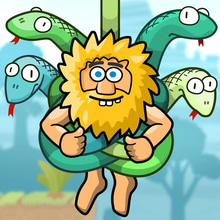
Adam is tied up. Not with normal ropes, not with something polite and predictable… but with snake-ropes. Yes, living ropes with attitude. Adam and Eve: Cut the Ropes takes that instantly ridiculous idea and turns it into a surprisingly clever physics puzzle adventure where your main tool is simple: cut the ropes in the right order, at the right moment, and try not to turn Adam’s rescue mission into a slapstick disaster. On Kiz10, it feels like a bite-sized brain workout wrapped in cartoon chaos, where every level is basically the game whispering, “Go ahead… cut it. I dare you.” 😅🪓
The objective is sweet and direct: help Adam reach Eve. But the path between them is packed with traps, obstacles, and rope-based nonsense that loves punishing rushed clicks. This isn’t a game where you can mash through. It’s a game where one lazy cut turns into a chain reaction of regret. And honestly, that’s where the fun lives.
🧠✂️ YOU’RE NOT CUTTING ROPES, YOU’RE CUTTING CAUSES AND EFFECTS
At first glance it looks simple: Adam hangs there, snakes coil around, and you think, okay, I cut this one, he drops, level done. Nope. The game quickly teaches you that every rope is a decision, not a decoration. Some ropes hold Adam in place. Some control his swing. Some keep him away from spikes. Some are the only thing stopping him from faceplanting into a hazard like a cartoon meteor.
You start learning to read the whole screen before doing anything. Where will Adam fall if I cut now? What will he hit on the way down? Is there a platform that will bounce him? Is there a trap that triggers the moment he touches a certain area? The game turns your finger into a tiny director of physics, and every level becomes a short scene: setup, tension, cut, consequences. Sometimes the consequences are perfect. Sometimes the consequences are Adam doing a dramatic flop into danger while you stare like, wow, I really did that to him 😭.
🧲🌀 SWING, DROP, LAND… AND PRAY A LITTLE
One of the best feelings in Adam and Eve: Cut the Ropes is nailing the swing math without even trying to “do math.” You cut one rope, Adam swings in an arc, you wait a beat, you cut the next rope, and he lands exactly where he needs to be like you planned it. That moment feels clean. It feels smart. It feels like you just solved a tiny mechanical riddle with timing and guts.
But the game loves messing with that confidence. The next level might add a second swing point, a new hazard, or a rope arrangement that looks familiar but behaves differently. And that’s the trick: it’s not repeating the same puzzle, it’s remixing the logic. You’re constantly adapting. One level rewards quick cuts. Another rewards patience. Another rewards cutting in a weird order that feels wrong until it suddenly works. The game is basically training you to stop trusting “obvious.”
🪤🔥 TRAPS THAT LOOK LIKE BACKGROUND UNTIL THEY BITE
This is where the chaos really shines. Hazards in this game aren’t just big scary spikes screaming “DON’T.” Some are sneaky. Some are placed where you’d naturally drop Adam. Some punish the exact movement your brain expects to be safe. You’ll see a platform and think it’s a landing zone, then realize it’s a setup for a trap. You’ll see an open space and think it’s freedom, then remember gravity is not your friend today.
And because the ropes are snakes, the whole vibe is slightly mischievous. It’s like the level is alive. Like the environment wants you to cut the wrong rope just to watch what happens. You’ll start hesitating, and that hesitation is good. It means you’re thinking like a puzzle player, not a button masher. The game rewards that shift.
😵💫🎭 THE FUNNIEST FAILS ARE ALWAYS ONE CUT AWAY FROM SUCCESS
Most levels don’t feel impossible. They feel close. You’ll almost solve it, then a tiny timing mistake makes Adam bump something at the wrong angle and everything collapses. That’s the kind of failure that makes you instantly restart, because you know you’re not stuck, you’re just a fraction off.
And the restarts don’t feel annoying because the levels are compact. You’re not replaying a long marathon. You’re replaying a short moment. Try again. Watch the swing. Cut earlier. Cut later. Reverse the order. The game becomes this satisfying loop of experimentation, where you’re testing physics like a playful scientist… except your test subject is Adam and he is not having a peaceful day 😅🧪
💘🌿 WHY THE “REUNION” GOAL MAKES EVERY PUZZLE FEEL WORTH IT
The Adam and Eve series always has that simple emotional hook: get to Eve. It’s not deep drama, but it gives your puzzle-solving a purpose. You’re not just clearing stages for points. You’re clearing stages so the couple can meet again, even if Adam arrives slightly traumatized and probably dizzy from swinging like a human piñata.
That tiny story motivation is surprisingly powerful. It makes the wins feel warmer. When you finally guide Adam safely through a nasty rope setup and he reaches Eve, it feels like a tiny victory scene you earned with your brain. Cute payoff, clean finish, next level please 😌💞
🧩🔍 HOW TO START THINKING LIKE THE GAME
If you want to get better fast, here’s the mindset that works: don’t cut first, observe first. Look at what the ropes are doing. Look at the hazards. Look at the likely path of movement. Then commit to a plan. And if the plan fails, don’t rage-click. Adjust one variable. Change the cut order. Change the timing by a half-second. Small changes matter a lot in physics puzzles because the path of motion is everything.
Also, accept that sometimes the “correct” solution feels slightly silly. This is a cartoon puzzle game. It wants playful logic. It wants you to experiment. If you treat it like a strict simulator, you’ll miss the fun. If you treat it like a weird rescue comedy with physics rules, you’ll solve it faster and laugh more 😈🪢
🏁✨ WHY IT’S PERFECT FOR QUICK PUZZLE SESSIONS ON Kiz10
Adam and Eve: Cut the Ropes is sharp, fast, and addicting in that classic “one more level” way. You’re solving 60 little puzzles that each have their own twist, and the game keeps you moving without feeling repetitive. It’s easy to understand, but it still makes you think. It’s goofy, but it still rewards precision. And once you get into the rhythm of swing-read-cut, you’ll start clearing levels with that smug little feeling of “okay, I get it now.” Until the next level humbles you. Instantly. 😂🐍
If you love physics puzzle games, rope cutting puzzles, and goofy adventure logic where timing is the difference between success and cartoon tragedy, this one hits hard. Cut smart, wait when you need to, and remember: the snakes are counting on you to mess up. Don’t give them the satisfaction. 🪓🐍💥













 Share
Share
 Embed
Embed


