💥🧱 Welcome to the Sweet Sound of Collapse
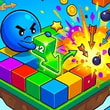
Blosics 2 is one of those games that looks polite until you realize it’s basically a controlled demolition hobby disguised as a puzzle. You’re staring at stacks of blocks, mostly calm, mostly stable… and you’re about to fire a heavy ball into them like you’re settling a personal argument with gravity. On Kiz10, it plays as a physics puzzle game where the goal isn’t “hit the target once and move on.” The goal is to make the structure panic, tip, slide, and finally give up… specifically the green blocks, the ones that actually matter. Everything else is just collateral. 😅
The first shot is always the lie. You line up a nice angle, you launch, something falls, you smile. Then the next level shows a taller tower, a nastier balance, and suddenly your “nice angle” doesn’t do anything except bounce off and insult the blocks. That’s when Blosics 2 becomes what it really is: a game about reading weight, predicting chain reactions, and choosing violence carefully.
🎯⚙️ Aiming Feels Simple, But The Tower Remembers
Mechanically, it’s clean. Aim with the mouse, choose your power, choose your ball size, and fire. No complex controls. No endless tutorial noise. But the depth comes from what happens after the hit. A ball doesn’t just knock one block away. It transfers momentum, it shakes the stack, it nudges weak points, it creates tiny gaps that become big failures two seconds later. And the best part is the suspense: that half-second where the tower is wobbling and you’re just watching, whispering “fall… fall… please fall.” 😭
You’ll learn quickly that Blosics 2 doesn’t reward “hit the green block directly every time.” Sometimes the right shot never touches a green block. Instead, you hit the support under it, or the connector beside it, or the one innocent-looking piece that’s holding the entire structure together like a stressed employee doing five jobs. The green blocks are the objective, but the structure is the puzzle.
🟩🧠 The Green Block Problem: Direct Hits Are Overrated
Green blocks are the ones you need to knock off the platform to pass the level. That makes them feel like the main targets, but chasing them head-on is often the fastest way to waste points and opportunities. A green block sitting in the middle of a stack is basically protected by everything around it. If you try to snipe it, you might remove one piece… and leave the rest standing like nothing happened.
Instead, the smarter approach is to treat green blocks like passengers on a sinking ship. Don’t punch the passenger. Sink the ship. Hit the base. Break the spine of the stack. Make the whole arrangement lean so gravity finishes your job with zero mercy and maximum satisfaction. 😈
And because the game is physics-based, every level has its own personality. Some towers are fragile and just need a clean tap in the right place. Others are stubborn and need you to “soften” them first, removing stabilizers, creating a tilt, then striking again where the wobble is already working for you.
🏗️💣 Ball Size Is a Budget, Not a Toy
Blosics 2 adds a delicious twist: you can often choose different ball sizes, and bigger balls usually cost more points. That changes how you think. This isn’t just “bigger is better.” Bigger is louder, sure. Bigger hits harder, sure. But bigger also drains your score, and if you throw giant balls every time, you may win… but you win ugly. The game quietly dares you to win smart.
Small balls are for precise nudges, removing one key block, or setting up a future collapse. Medium balls are for controlled violence, the kind that shakes a tower without turning the whole shot into a gamble. Big balls are for moments where you’re certain the structure is ready to fall and you just need a single dramatic punch to send the whole thing off the stage. The fun is learning when each one matters. Because the “wrong” size can be worse than a bad angle. A tiny ball might do nothing to a thick stack. A huge ball might blow apart the wrong side and accidentally keep the green blocks safe. Yeah… the tower can be petty. 😅
🌀👀 The Best Shots Happen Before You Shoot
Here’s the thing most players don’t want to hear: the strongest move is staring at the tower for two seconds. Not forever. Just long enough to spot the real weak point. Look for overhangs. Look for thin supports. Look for green blocks sitting on ledges that can be kicked out from under them. Look for “hinges,” places where one block connects two sections. Those hinge blocks are gold. If you break a hinge, the structure splits, and once it splits, gravity becomes your teammate.
Blosics 2 is also the kind of game where you should pay attention to the platform edge. Blocks don’t need to explode. They need to leave the stage. So sometimes the best play is not “smash inward.” It’s “push sideways.” A clean lateral shove can slide multiple blocks off the platform like you’re sweeping crumbs off a table. Simple, mean, effective. 🧹😈
🎬💥 Chain Reactions Feel Like Little Movies
The best moments in Blosics 2 aren’t the shots. They’re the aftermath. You fire, the ball hits, the tower shifts, one block slides, then another, then the whole stack leans in slow motion. You watch a green block wobble near the edge like it’s deciding whether to betray its friends. Then it tips. Then it falls. Then two more fall with it. And for a second you feel like a genius engineer who definitely planned every millimeter of that collapse. 😂
This is why the game stays addictive. You’re not chasing random luck. You’re chasing the perfect collapse. The perfect fall that drops exactly the blocks you need with minimal waste. It becomes a craft. Not a loud craft, but a satisfying one. And when you fail, the failure is usually honest. You hit too high. You hit the wrong side. You used too much power. You broke the tower in a way that actually stabilized the green blocks. (Yes. That can happen. It’s insulting.)
🧠✨ Practical “Win Cleaner” Thinking
If you want your runs to feel sharp instead of messy, treat your first shot like a setup shot. Don’t try to finish instantly unless the tower is clearly fragile. Use the first hit to create instability: remove a key support, create a lean, open a gap. Then use the next shot to capitalize. This two-step approach often beats the “giant ball, full power, hope” strategy, and it usually costs fewer points too.
Also, don’t fall in love with one angle. If a shot doesn’t work, the answer is often not “same shot but harder.” The answer is “different problem.” Aim lower. Aim at the opposite side. Use a smaller ball to remove the one piece that’s absorbing your impact. Towers are systems. Hit the system, not the symptom.
Blosics 2 on Kiz10 is perfect if you like physics puzzle games, demolition challenges, and that clean dopamine rush of watching a structure collapse because you finally found its weak point. It’s thoughtful, destructive, and weirdly elegant when you play it well… like a demolition artist with a mouse cursor. 💥🧱😄




 3.5 (20 votes)
 Share
Share
 Embed
Embed