🌴🐾 Welcome to a Jungle of Matching Trouble
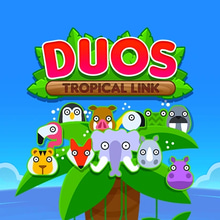
Duos Tropical Link looks like a vacation postcard until you touch the first tile and realize the island is basically a logic trap with palm trees. You’ve got a board full of animals staring back at you, all colorful and innocent… and your job is to connect identical pairs using a clean path. Sounds easy, right? Then the board starts tightening, the timer starts breathing down your neck, and suddenly you’re squinting at corners like a detective who’s late for a flight. On Kiz10, this is a classic “connect two” puzzle, the kind that feels relaxing for the first ten seconds, then turns into a quick-thinking rhythm game where your brain and your eyes have to cooperate or everything collapses into a reshuffle panic. 😅
The charm is in the contrast. The theme is tropical, cute, almost cozy. But the gameplay? It’s sharp. It asks you to scan, plan, and move with intent. You’re not just matching because something is there. You’re matching because it unlocks space, opens new routes, and prevents the board from turning into a dead-end mess. Every pair you remove is like cutting a vine in a jungle path. One smart cut and the whole route opens. One lazy cut and you’re stuck hacking at leaves while the clock laughs. 🌿⏱️
🧠🧩 The Rule That Changes Everything
Duos Tropical Link isn’t “match any two identical tiles.” It’s “match two identical tiles only if a valid connection path exists.” That path usually has strict limits, like a small number of turns, and it must travel through empty space. In other words, the board itself is the puzzle, not the animals. The panda isn’t the problem. The empty corridors between pandas are the problem.
That single rule makes your decisions feel heavier. You start thinking in lanes. You stop seeing the grid as a bunch of pictures and start seeing it as a map of possible routes. Can I connect those flamingos now, or do I need to clear the tiles around them first so they can “see” each other? If I remove this pair, will it free a hidden match behind it? If I waste time on an easy pair in the wrong area, will I lose access to a more important pair that’s currently blocking half the board? It’s small strategy, but it stacks fast. 🧠✨
🐯🔎 The Board Scan: Eyes First, Hands Second
Here’s the funny thing: the best move is often the one you don’t click immediately. The game rewards a quick scan before you act. You look for pairs that are already linkable, sure, but you also look for pairs that will unlock other pairs. Clearing the right tiles early can turn the board from cramped to smooth, like untying a knot. Clearing the wrong ones can keep the knot tight and force you into emergency mode later.
And emergency mode is real. You’ll hit moments where you can feel the board getting awkward. The remaining tiles are clustered. The open corridors are shrinking. Your options are fewer. This is where players either stay calm and methodically open lanes… or start clicking like a startled bird and hope a miracle appears. The game lets you learn the hard way that miracles are expensive. 😭
🦩⚡ Speed vs. Planning, the Classic Island Argument
Some tile-link games are purely slow and thoughtful. Duos Tropical Link has that “think fast” flavor. You want to be efficient because time matters, but you also can’t rush blindly because a rushed match can block future matches. It’s a balancing act. You’re basically doing two tasks at once: clearing pairs and managing the board’s future shape.
When you’re playing well, it feels smooth, like you’re dancing through the grid. Match, match, open a lane, match again, chain another pair that just became available, and suddenly you’re moving with confidence. When you’re playing badly, it feels like being lost in a tropical maze with a stopwatch. You keep finding pairs, but none of them connect, and you start relying on your rescue tools to survive. 😅⏳
🧰🧨 Lifelines: Hints, Shuffles, and the “Save Me” Button
Duos Tropical Link usually gives you a limited number of hints and shuffles, and those tools are basically your emergency backpack. A hint is what you use when your eyes are tired or the board is hiding an obvious connection in plain sight. A shuffle is what you use when the board is technically alive but practically hopeless, when everything is locked behind everything else and you can feel the dead-end creeping closer.
The trick is not treating these tools like toys. If you spend them early just because you feel lazy, you’ll regret it later when the board becomes genuinely jammed. But if you hoard them forever like a dragon guarding treasure, you’ll also lose runs you could’ve saved. The sweet spot is using them with intention. Use a hint when you’ve truly scanned and you’re burning time. Use a shuffle when the board’s structure has become the enemy. It’s not cheating, it’s survival. 🧠🛟
🌺🧩 Little Moments That Make It Addictive
The satisfying part isn’t just removing tiles. It’s the feeling of unlocking space. You clear a pair and suddenly two other pairs become possible because the corridor opens. That’s the “click” moment, when the puzzle stops feeling random and starts feeling solvable. You’re not guessing anymore, you’re steering.
And the animal theme helps because it’s easy to read. The icons are distinct, the colors pop, and you can spot duplicates quickly. That means the challenge doesn’t come from confusion, it comes from path logic. Your brain isn’t struggling to identify tiles, it’s struggling to route them. That’s a good kind of struggle, the kind that feels fair even when you fail. 🐊✨
🏝️🎯 How to Play Like a Real Tile-Link Survivor
If you want to feel in control instead of constantly reacting, focus on opening the board. Prioritize matches near the edges and in crowded clusters where tiles are blocking multiple routes. Keep the center from becoming a solid wall. Try not to leave isolated single tiles trapped behind a ring of others, because those “lonely leftovers” are what force shuffles later.
Also, watch your pacing. If you get a clear rhythm going, you’ll spot connections faster. If you hesitate too much, the timer pressure makes you sloppy. It’s weirdly psychological: the calmer you are, the faster you become. The more you rush, the slower you get, because you start missing obvious paths. The board doesn’t beat you with difficulty spikes, it beats you with your own impatience. 😄⏱️
Duos Tropical Link on Kiz10 is one of those puzzle games that feels light but stays sharp. It’s cute on the outside, tactical on the inside, and incredibly satisfying when you clear a messy board without wasting your lifelines. You’ll start a round thinking you’re just matching animals, and you’ll end it realizing you were basically managing traffic in a jungle airport. And honestly? That’s kind of the fun. 🌴🐾





 Share
Share
 Embed
Embed