🧱🗡️ THE KEEP DOESN’T WANT YOU HERE, SO CLIMB ANYWAY
Juniper Keep Assassins drops you into a mission that feels like it was scribbled onto a dossier with trembling hands: infiltrate the keep, push upward, and tear a path through a corporate nightmare that has way too many blades and way too many machines. You’re part of the Juniper squad, you’re going after the Haima Corporation, and the place they’ve built is less “fortress” and more “vertical argument with gravity.”
You press play on Kiz10.com and there’s no gentle onboarding. It’s immediately you, the walls, the air, and the quiet realization that this game expects you to move like you mean it. Jump. Cling. Scale. Drop. Strike. Repeat. If you hesitate, something sharp arrives to remind you that hesitation is a luxury item.
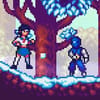
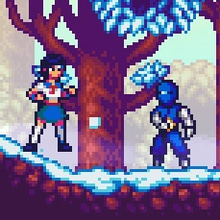
The vibe is retro in the best way, like pixel art with teeth. The animations are snappy, the movement is hungry, and the whole world feels built for one purpose: to tempt you into going faster than your reflexes can handle, then punish you the moment you get cocky. It’s not mean for no reason. It’s mean because it wants to feel like an old-school action platformer where every clean run is earned, not gifted.
🧗♂️💥 WALLS AREN’T OBSTACLES, THEY’RE YOUR HIGHWAY
Most platform games treat walls as boundaries. Juniper Keep Assassins treats walls like a second floor. The climbing is the heartbeat of everything. You’re not just hopping over gaps; you’re attacking the level from angles it doesn’t want you to use. You leap toward a surface, stick, slide, climb, then spring away like you’re allergic to standing still. It feels acrobatic, but also practical, because the keep is designed to trap “normal” movement. The game is basically whispering, stop walking like a citizen, start moving like an intruder.
And once you accept that, something clicks. The level design turns into a playground of routes. High path, low path, risky path, “I can totally make that jump” path. Your brain starts mapping the stage while your hands are already executing it. You’ll catch yourself doing tiny micro-plans mid-jump like, okay I’ll cling here, drop there, bait that ninja, take the upper ledge, don’t touch the spikes, don’t touch the spikes, why am I always touching the spikes. 😅
The best part is how the climbing makes you feel clever even when you’re panicking. You can improvise. You can escape upward. You can ditch a bad fight by turning the wall into an exit. It’s vertical parkour with a blade in your hand, and it’s honestly rude how good it feels when you chain it smoothly.
🤖🩸 MECHANICAL MONSTERS AND NINJAS WHO FIGHT LIKE THEY HAVE A UNION
The enemies aren’t just “there.” They feel placed like threats with opinions. Assassin ninjas show up with that quick, punishing energy where one mistake turns into a hit, and one hit turns into you scrambling for space. Mechanical monsters bring a different kind of pressure: heavier, scarier, less “duel” and more “problem.” The keep throws variety at you so you never settle into a single comfortable rhythm. Comfortable is dangerous here.
You’ll have moments where you think you’ve got the timing down, you’re slicing through, moving clean, feeling stylish… and then a new pattern appears and the game forces you to relearn humility in real time. That’s the charm. It’s not a slow grind. It’s a fast conversation between you and the level, and the level is aggressive.
But it’s also fair in that old-school way. When you get hit, you usually know why. You got greedy. You committed to a jump without checking what was on the other side. You attacked too early. You tried to rush a fight that wanted patience. The game doesn’t hide the lesson. It just delivers it with a sword.
🎮⚡ THE COMBAT FEELS LIKE A BUTTON PRESS WITH CONSEQUENCES
There’s a specific satisfaction to retro action combat when it’s tight. Juniper Keep Assassins has that “clean strike” feeling, where hitting the right moment makes you feel sharp, and missing makes you feel exposed. This isn’t a mash-and-win fantasy. It’s more like, pick your moment, commit, and then move before the world punishes you for standing still.
Because standing still is how you get surrounded. And being surrounded in a vertical fortress is extra insulting because the exits are literally right there, you just didn’t take them. The game teaches you to fight while repositioning, to treat combat like part of movement, not a pause in movement. Slash, hop, cling, drop behind an enemy, slash again, then climb away before the next threat arrives. You start feeling like you’re choreographing chaos.
And yes, you will also have ugly fights. The kind where you panic, swing too much, bounce off a wall, fall into danger, and then your character gets punished while you whisper “this was avoidable” like a prayer. It was avoidable. That’s why you’ll restart immediately. Not because the game is unfair, but because your pride is louder than your patience.
🌙🎵 CHILL CHIME SOUNDTRACK, UNCHILL SITUATION
There’s something hilarious about a retro-inspired platformer that can sound almost playful while it’s actively trying to end you. The whole experience feels like a late-night arcade dream: bright pixels, crisp movement, tense timing, and that constant forward push. You’ll get into a flow where you’re barely thinking in words. It becomes rhythm. Jump. Stick. Slide. Strike. Jump. The keep turns into a beat, and you’re trying to stay on tempo.
That’s when you start playing better. When you stop narrating every decision and start trusting your hands. Your reactions get cleaner. Your routes get smarter. You stop taking fights in stupid places. You stop landing with your face first. You start using walls like tools. And suddenly the game feels less like survival and more like speedrunning your own competence.
Not perfect competence. Let’s not get carried away. You’ll still die to something absurd. But you’ll die faster, which somehow makes it funnier. 😭
🧠🔥 THE KEEP IS A PUZZLE MADE OF MOMENTUM
Here’s the trick that makes Juniper Keep Assassins so addictive: it’s secretly a momentum puzzle. Not a logic puzzle with numbers, but a movement puzzle where the “solution” is a clean route executed with confidence. The level doesn’t just ask can you get there. It asks can you get there without breaking your flow. Because once your flow breaks, everything gets harder. Your jumps are late. Your climbs are sloppy. Your combat is desperate. Your spacing collapses. The keep senses weakness like it’s a shark.
So the game gently pushes you toward mastery through embarrassment. You learn that the safest choice is often the fastest one, because speed keeps you out of bad situations. You learn that rushing blindly is not speed, it’s gambling. Real speed is control. Real speed is knowing when to cling and when to leap. Real speed is choosing fights that don’t trap you. Real speed is leaving.
Leaving is a skill. Some players never learn it. They swing until they lose. The better runs are the ones where you disengage, climb away, reposition, then re-enter on your terms. That’s assassin behavior. That’s Juniper squad energy. That’s the difference between “I’m playing a retro platformer” and “I’m surviving a keep designed by maniacs.”
🏁🗡️ WHY YOU’LL HIT RESTART WITH A SMIRK
Juniper Keep Assassins on Kiz10.com is built for that exact feeling: you fail, but you can see the fix. You missed a wall grab by a pixel. You jumped too early. You attacked insteads of climbing. You chased a kill when the smarter play was to move. The mistake is clear, which makes the retry irresistible. Your next run is immediately better, even if only by a little. And those little improvements stack until you’re suddenly clearing sections that used to feel impossible.
If you love action platformer games with wall climbing, ninja enemies, retro pixel style, tight timing, and that old-school “earn it” vibe, this one is a perfect storm. It’s fast, it’s sharp, it’s sometimes cruel, and it’s the kind of game that makes you sit up straight without asking politely. Now climb. The keep is waiting. 🧱😈🗡️














 Share
Share
 Embed
Embed