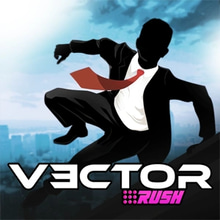
The city does not fall politely. It rips itself apart mid sentence. One moment the skyline is just glass and concrete, the next it is a jagged heartbeat of collapsing towers, broken streets and dust clouds rising like ghosts. Somewhere inside that chaos, a single vector silhouette slams a door open, looks down at the cracking floor and understands one simple rule. If you stop moving, you are gone. Welcome to Vector Rush. 🏙️💥
This is not a peaceful training run. An unexpected earthquake has punched the city in the ribs, and every rooftop you step on feels like it might decide to disappear out from under you. Floors tilt, walls crumble, whole buildings lean at wrong angles. Your character, drawn in that clean shadow style, bolts out of the ruined office and straight into a parkour sprint where hesitation is more dangerous than any enemy. You are not just running to a finish line. You are running away from a disaster that keeps trying to erase the path behind you.
You feel that urgency in the first few seconds. The camera pulls back just enough to show you the roof edges on both sides, the gap ahead, the dust cloud chasing near the horizon. Your vector runner reacts with tight, athletic moves that look simple at first. A leap from one building to the next. A slide under a low beam. A quick tuck to clear scattered debris. But each action sits on top of something bigger a rhythm of survival that you slowly learn to hear.
Earthquake above the streets 🌪️🏢
Every level in Vector Rush plays like a slice of a disaster movie, except you are the one choreographing the stunts on the fly. Rooftops are not flat carpets; they are fractured, uneven, and full of nasty surprises. A safe looking stretch hides a sudden gap. A comfortable platform ends in a broken edge where the rest of the building has already fallen. Satellite dishes, pipes, air conditioners and random bits of rooftop furniture suddenly become obstacles you have to react to, not decoration.
The quake is not just a story detail. It is a personality. Cracks race along the concrete under your feet. Background towers sink or tilt as you rush past. Sometimes you catch a glimpse of a building actually sliding down in the distance, like the city is slowly rearranging itself into a maze meant to trip you. That visual noise keeps your brain awake. You are never allowed to run on autopilot for long.
And in the middle of it all, your vector character stays sharp. Clean lines, clear moves, zero wasted animation. When they jump, they commit. When they slide, it is a clean, focused motion that cuts under a beam with just enough space to breathe. It feels like watching a professional freerunner trapped inside a glitchy disaster documentary.
Parkour flow on a knife edge 🏃♂️⚡
Vector Rush is a runner game, yes, but it is also a quiet lesson in flow. Early on, you will smash into everything. You will jump too early and hit the side of a wall instead of the top. You will slide when you should have leapt and watch your character disappear into the hole you were meant to clear. You will mistime simple gaps because your eyes are still busy staring at the earthquake in the background. It is messy, and a little funny, and incredibly human.
Then something clicks. You finally wait that extra heartbeat before a jump, and suddenly you land perfectly on the far roof instead of skidding off the edge. You slide under a pipe at the last possible instant and pop up already lined up for the next leap. You stop reacting to each obstacle like a surprise and start reading the rooftop ahead in phrases. Low beam, gap, crate, small drop. Jump, slide, hop, adjust. The world stops feeling random and starts feeling like a sentence you are learning to pronounce.
That is when Vector Rush becomes satisfying. The game rewards timing, not panicked mashing. Shorter taps become quick hops, longer presses stretch your arc just enough to clear a wider gap. Slides are not just emergency reactions; they become part of your rhythm, letting you stay low, safe and fast as the city tries to punch you in the knees with broken concrete. When you chain three or four clean moves in a row, you feel that little electric buzz that only a good parkour line can give.
Coins, upgrades and tiny victories 💰🎽
The earthquake might be the headline, but your progress lives in the coins scattered along the rooftops. Golden trails hang in the air just far enough off the safe path to tempt you into risk. You can technically survive a level while ignoring them, but you will not want to. Each coin you grab feeds into unlocks and new features that make future runs more interesting.
Suddenly you are not just escaping; you are investing. Coins become the way you unlock new looks, new boosts, small advantages that stack up over time. Maybe you go for cosmetic changes first, because you want your vector runner to feel more like your own shadow. Maybe you prioritize upgrades that help with survivability or earning, so each attempt spits out more rewards even if you mess up halfway through the level.
The best part is how these coins change your choices. A clean, safe line might avoid risk but miss out on shiny clusters hanging over a scary gap. A trickier route might force a late jump over a collapsing section but rewards you with a line of coins that clink into your total like a tiny round of applause. You are constantly asking yourself is it worth it and half the time the answer is yes just because the challenge looks fun.
Learning the rhythm of disaster 🎧🧠
There is a strange kind of calm hidden inside Vector Rush, buried under all the chaos. Once you stop treating every obstacle like an emergency, the game becomes about reading patterns. Certain level layouts teach you habits. Long flat run. Sudden low beam. Gap just after. Short cluster of crates. Drop. You start to recognize these sequences and prepare your hands before your eyes finish sending the warning.
That is where the human side of the game shows up. You will have runs where everything flows, every timing feels natural, and your runner glides across the tops of collapsing buildings like they own the city. You will also have runs where your brain is half asleep, you jump at the worst moments, and you hit restart with a small laugh because you know that was entirely on you.
The more you play, the more the earthquake becomes background music. You still see buildings fall, but you no longer panic every time a wall cracks in the distance. You focus on footprints, on the edge of each roof, on the timing between one obstacle and the next. You become the calm point inside the chaos, and that feeling of control is addictive.
Desktop precision and mobile reflexes 🖱️📱
Controls in Vector Rush are deliberately simple so the difficulty lives in your decisions, not in fighting the interface. On desktop, you use the mouse to handle your main actions. A click or gesture lets you jump, another triggers a slide, and your timing turns those basic moves into life saving tricks as the rooftops shift underneath you. It feels quick and direct, like your hand is wired straight to your runner’s legs.
On mobile, the touch controls keep that same energy. You tap or swipe on the screen to make your vector character jump between buildings or slide under obstacles. The left and right sides of the display respond in a way that feels natural after a few attempts, turning your thumb into a tiny parkour coach that shouts now at exactly the right moment. Whether you are playing on a big monitor or a phone screen, the game keeps the input clean so you can focus on the quake, the gaps and those narrow edges that make your stomach flip.
Because the core actions are consistent across devices, switching between platforms feels natural. You might grind a few levels on your computer, then grab a quick run on your phone later just to see if you can beat your previous performance. Your muscle memory follows you, and every near miss becomes another tiny lesson in how close you can push your timing.
Why Vector Rush feels at home on Kiz10 🌐🔥
Vector Rush leans perfectly into what makes Kiz10 sessions so dangerous for your free time. You do not waste minutes on downloads or installs. You open the page, the game loads inside your browser, and suddenly you are standing on a rooftop that is absolutely not earthquake proof. Each level is short enough to fit into a quick break, but tense enough that you will almost always say one more run even when you should probably stop.
It is also clearly tuned for replay. Levels invite you to come back, grab more coins, clean up your mistakes and find smoother lines across the wrecked skyline. That replayability, combined with the visual personality of the vector art and the collapsing city, gives the game its hook. You are not just ticking off stages on a list; you are slowly mastering a dangerous route through a place that looks like it wants you gone.
If you enjoy parkour games, runner games and any challenge where a single mistimed jump can undo a perfect streak, Vector Rush is a natural choice on Kiz10. It delivers a fast, stylish escape story told with silhouettes, quakes and split second decisions. Every time you clear a level with a full pocket of coins and both feet still on the roof, you get that tiny spark of pride that says yeah, I beat the city this time. And the earthquake will be waiting when you come back for the next run. 🌐🏃♀️



 4 (188 votes)
 Share
Share
 Embed
Embed